
Automatic Doors

What Is a Balanced Door? Design, Function, and Benefits Explained

Walk into almost any landmark office tower, museum, or high-end retail space in Manhattan and you have almost certainly passed through one without realizing it. Balanced doors are one of the most technically refined entrance systems in commercial architecture, combining an offset pivot mechanism with precision engineering to deliver effortless operation, superior energy control, and a clean aesthetic that standard swing doors simply cannot match. This guide covers how they work, where they are used, and why architects and property managers across New York and New Jersey continue to specify them for demanding commercial environments.

Diagram of a balanced door system showing the offset pivot mechanism and door panel weight distribution
The offset pivot system is what separates a balanced door from a standard swing door. Weight is distributed across the pivot axis rather than loaded entirely on the hinge side.

What Is a Balanced Door? The Engineering Behind the Design

A balanced door is a type of commercial entrance door that pivots on an offset axis rather than swinging from a traditional side hinge. The pivot point is positioned roughly one-third of the way across the door panel width, which distributes the door’s weight on both sides of the pivot. This distribution is what makes the door feel light and controlled to the user regardless of the actual size or weight of the panel.

The result is a door that can be opened with minimal effort even when it is large, heavy, and subject to wind pressure or building stack effects. That combination of low operating force and structural resilience is why balanced doors appear consistently in the most demanding commercial entrances, from airport terminals to urban office towers to hospital lobbies.

What Is a Balanced Door Pivot System vs. a Standard Hinge

Understanding the difference between a balanced pivot and a conventional door hinge clarifies exactly why the two perform so differently in commercial use:

Feature Balanced Door (Offset Pivot) Standard Swing Door (Side Hinge)
Pivot location Approx. one-third from the pull side Edge of the door frame
Weight distribution Balanced across pivot axis Full weight loaded on hinge side
Operating force required Very low, even for oversized panels Increases significantly with door size
Wind resistance High, pivot absorbs lateral pressure Moderate, can be difficult in high-wind conditions
Swing path over building line Minimal (typically under 18 inches) Full door width swings out
ADA compliance Achievable with low operating force Requires operator or low-energy assist

How Balanced Door Systems Work in High-Traffic Commercial Environments

The mechanics of a balanced door go beyond just the pivot point. The full system includes a floor closer, an overhead concealed closer, and the pivot hardware itself, all working in coordination to control the door’s speed, return force, and hold-open behavior. This makes the system more mechanically complex than a standard swing door but far more capable in environments where doors cycle hundreds of times per day.

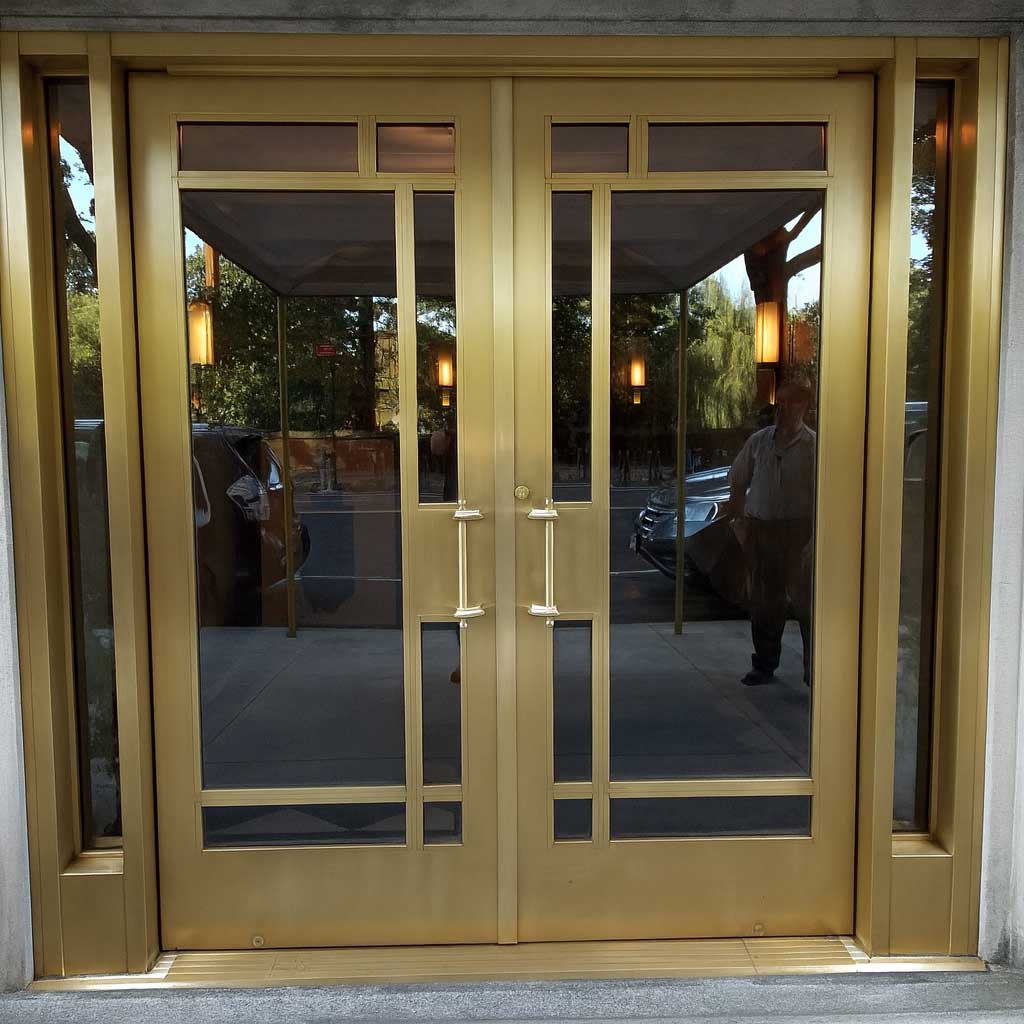
Balanced door installation at a commercial building entrance in Manhattan New York
A balanced door installation at a commercial property in Manhattan. The minimal swing path over the sidewalk line is a critical requirement in dense urban environments.

The Offset Pivot and Why It Matters in Urban Settings Like New York City

In dense urban environments, the swing path of a door over the public sidewalk is a regulatory and practical issue. New York City building codes restrict how far a door can project over the building line, typically limiting outward swing to no more than 18 inches. A standard side-hung door on a wide commercial opening can easily exceed that limit, creating code compliance problems and pedestrian hazards.

The offset pivot on a balanced door solves this directly. Because the door pivots on an interior axis rather than swinging from the edge, the exterior projection of the door is dramatically reduced. This is one of the primary reasons that balanced doors became so prevalent in Manhattan and other dense urban markets where large commercial entrances and tight sidewalk clearances coexist.

Where Balanced Doors Are Specified in Commercial Architecture

Balanced doors appear across a wide range of commercial building types where the combination of high traffic volume, large opening sizes, and aesthetic expectations rules out simpler door systems:

  • Class A office buildings: Lobby entrances with oversized glass panels and monumental proportions benefit from the effortless operation and clean sightlines of a balanced system.
  • Hotels and hospitality properties: High guest volume and a premium aesthetic expectation make balanced doors a natural fit for main entrances and ballroom corridors.
  • Museums and cultural institutions: Large, heavy door panels can be operated easily by visitors of all ages and abilities.
  • Airports and transit hubs: Continuous cycling in high-wind airside and landside environments is where the wind resistance of the balanced mechanism proves its value.
  • Healthcare facilities: Low operating force supports accessibility requirements, and the controlled close speed reduces noise and impact in patient care settings.
  • Retail flagships: Brand-conscious retailers use oversized balanced door panels as an architectural statement at street level, particularly in Manhattan and urban New Jersey markets.
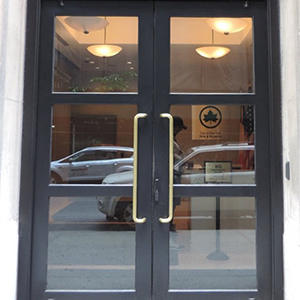
Large format balanced door entrance at a commercial property in New York
Large-format balanced door entrance at a commercial property. Oversized panels are one of the primary use cases where the balanced pivot system outperforms standard swing hardware.

Balanced Doors and ADA Compliance

The Americans with Disabilities Act (ADA) sets specific requirements for the operating force allowed on accessible doors in commercial buildings. Interior doors must require no more than 5 pounds of force to open, while exterior doors have a higher threshold but must still be operable without tight grasping or twisting.

How Balanced Automatic Doors Meet ADA Operating Force Requirements

Because the balanced pivot distributes weight across the door panel, the actual force required to operate the door is significantly lower than a side-hung door of the same size and weight. A well-specified and properly maintained balanced door can meet ADA force requirements without an automatic operator in many applications, which can reduce installation cost compared to adding a low-energy swing door operator to a standard hinge door.

When ADA compliance is a primary driver of the specification, it is worth reviewing our detailed look at commercial swinging door service and ADA requirements alongside balanced door options, since the right choice depends on opening size, traffic volume, and budget.

Energy Efficiency Benefits of Balanced Door Systems

Energy performance at the building envelope is a growing priority for commercial property owners in New York and New Jersey, driven by both operating cost pressures and compliance requirements under the NYC Energy Conservation Code and New Jersey’s energy standards.

How Balanced Doors Reduce Air Infiltration and Combat Stack Effect

Balanced doors contribute to building energy performance in two primary ways:

  • Reduced air infiltration: The precision alignment of the balanced pivot system, combined with high-quality perimeter seals and threshold seals, minimizes gaps around the door panel. Less air movement through the entrance means lower heating and cooling loads.
  • Stack effect management: In tall commercial buildings, the pressure differential between lower and upper floors creates a stack effect that forces air through every available gap at lower levels. The controlled operation and tight sealing of a balanced door system is significantly more effective at limiting this infiltration than a loosely fitted standard door.

For buildings pursuing LEED certification or targeting energy performance benchmarks, specifying balanced doors at primary entrances is a documented strategy for improving envelope performance metrics.

Balanced Doors vs. Other Commercial Entrance Systems

Balanced doors are not the right solution for every opening. Understanding how they compare to other commercial entrance types helps architects and property owners make the right specification decision:

Door Type Best For Limitations
Balanced Door Large, heavy panels; dense urban sites; monumental entrances Higher hardware cost; requires professional maintenance
Automatic Sliding Door High-volume retail and healthcare; hands-free operation Wider structural opening required; not ideal for narrow facades
Revolving Door Maximum energy efficiency; high-rise lobbies Highest cost; requires adjacent swing door for ADA compliance
Standard Swing Door Lower traffic, smaller openings, tighter budgets High operating force on larger panels; full swing path over building line
Manual Sliding Door Interior partitions; lower traffic applications Not suitable for primary exterior commercial entrances

For a broader look at the full range of commercial entrance options, our commercial door types guide covers each system in detail.

Materials, Finishes, and Customization for Balanced Doors

Balanced doors are specified in a wide range of materials and finishes, making them adaptable to virtually any architectural program:

  • Aluminum: The most common framing material for commercial balanced doors. Lightweight, corrosion-resistant, and available in a full range of anodized and painted finishes.
  • Stainless steel: Used in high-end retail, hospitality, and institutional applications where a premium finish and maximum durability are required.
  • Bronze: A classic specification for landmark buildings, cultural institutions, and historic properties where patina and architectural character are priorities.
  • Glass infill: Most commercial balanced doors use tempered or laminated glass infill panels. Insulated glass units can be specified for improved thermal performance.
  • Wood and specialty materials: Interior balanced doors in hospitality and high-end office environments can incorporate wood veneer, decorative metal, or other specialty infill materials.
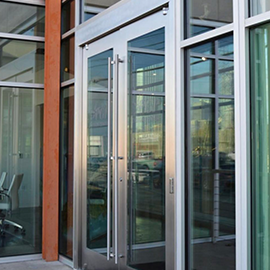
Commercial balanced door with aluminum frame and glass panels at a modern office building entrance
Aluminum-framed balanced doors with full glass infill panels are among the most common specifications for modern commercial office buildings in New York City.

Maintenance Requirements for Balanced Door Hardware

The floor closer and overhead concealed closer in a balanced door system require periodic adjustment and lubrication to maintain proper operation. Pivot hardware should be inspected for wear, and seals should be checked and replaced as needed to maintain energy performance. Because the mechanical components are more complex than a standard hinge, balanced door maintenance is not a DIY task.

A scheduled commercial door maintenance program that includes balanced door hardware inspection is the most cost-effective way to prevent premature wear on the pivot system and floor closer, which are the most expensive components to replace. Buildings that skip scheduled maintenance typically face significantly higher repair costs and more frequent downtime.

For a complete look at what routine upkeep should include, our automatic door maintenance checklist for commercial buildings covers the full scope of what a proper inspection should address.

Frequently Asked Questions About Balanced Doors

What is a balanced door and how does it differ from a regular door?

A balanced door pivots on an offset axis located approximately one-third of the way across the door panel, distributing the panel’s weight on both sides of the pivot. A standard door hangs entirely from hinges on one edge, meaning all of the door’s weight is loaded onto the hinge side. The balanced pivot system results in much lower operating force and better performance in wind and high-traffic conditions.

Are balanced doors ADA compliant?

Yes, balanced doors can meet ADA operating force requirements when properly specified and maintained. Because the pivot distributes the door’s weight, the force required to open the door is significantly lower than a side-hung door of equivalent size. The ADA sets a maximum of 5 pounds of interior door operating force and has separate guidance for exterior doors, both of which a well-maintained balanced door can satisfy.

What types of buildings typically use balanced doors?

Balanced doors are most common in Class A office buildings, hotels, museums, airports, hospitals, and high-end retail environments. They are particularly prevalent in dense urban markets like Manhattan where limited sidewalk clearance restricts how far a door can swing over the building line.

How much do balanced doors cost compared to standard commercial doors?

Balanced door hardware carries a higher upfront cost than standard swing door hardware due to the precision pivot system and concealed closer components. Total installed costs vary significantly based on panel size, material, glazing, and hardware specification. Contact our team directly for a project-specific estimate.

Do balanced doors require special maintenance?

Yes. The floor closer, overhead concealed closer, and pivot hardware all require periodic inspection, adjustment, and lubrication by a qualified door service technician. Annual preventative maintenance is strongly recommended to protect the pivot hardware and maintain proper operating force and close speed.

Can a balanced door be automated?

Yes, balanced doors can be integrated with low-energy automatic operators that allow hands-free activation via push plates, motion sensors, or access control systems. This is a common specification in healthcare facilities and ADA-accessible entrances where hands-free operation is required. Our team can assess the right automation approach for your specific balanced door configuration.

Get Expert Guidance on Balanced Door Specification and Installation

Balanced doors represent one of the more technically demanding entrance specifications in commercial architecture, and getting the hardware selection, installation, and ongoing maintenance right makes a significant difference in long-term performance. At Door Automation Corporation, we work with architects, property managers, and general contractors across New York City, Long Island, and New Jersey on balanced door projects of all scales.

Contact us today to discuss your project requirements and get expert guidance on balanced door specification, installation, and service.

How to Reduce Automatic Door Repair Costs for Commercial Properties

For commercial property owners and facility managers in New York and New Jersey, automatic door repair is an unavoidable operating expense. The question is not whether you will spend money on repairs over the life of your door systems, but how much. The difference between a reactive maintenance approach and a proactive one can easily amount to thousands of dollars per door per year. Understanding how to reduce automatic door repair costs comes down to three things: scheduled preventative maintenance, early fault detection, and the right service relationship with a qualified door contractor.

Automatic doors at a commercial hospital facility requiring regular preventative maintenance to reduce repair costs
High-traffic automatic door installations in healthcare facilities accumulate wear faster than lower-volume applications, making a structured preventative maintenance schedule essential to controlling repair costs.

How to Reduce Automatic Door Repair Costs: Start With Prevention

The single most effective way to lower your automatic door repair bills is to stop treating maintenance as optional. The mechanical components in an automatic door system, including the operator, sensors, hinges, closers, and threshold hardware, all degrade with use. When that degradation is caught and corrected early, the repair is minor. When it is ignored until the system fails, the repair is major, and in many cases the door is out of service while you wait for parts or scheduling.

A structured commercial automatic door maintenance program is the foundation of cost control for any building with automatic entrances. It is not an added expense, it is a cost reduction strategy, and the numbers consistently support that position.

Reactive vs. Preventative Maintenance: The Real Cost Difference

The cost gap between reactive and preventative maintenance becomes clear when you look at what each approach actually produces over time:

Approach Typical Annual Cost Per Door Risk Level Downtime Risk
Reactive only (repair when broken) $800 to $2,500+ High High, often unplanned
Preventative maintenance only $300 to $600 Low Minimal, planned
Preventative plus minor repairs $400 to $900 Low to moderate Very low

The reactive approach looks cheaper until the first major failure. A failed operator motor, a damaged sensor assembly, or a broken pivot component can cost $1,500 to $4,000 or more to repair on an emergency basis, dwarfing several years of preventative maintenance visits in a single service call.

The Recommended Preventative Maintenance Schedule for Commercial Automatic Doors

Industry best practice calls for a minimum of two preventative maintenance visits per year for commercial automatic doors in normal service. For high-traffic installations in retail, healthcare, or transit environments, quarterly visits may be warranted.

How to Lower Automatic Door Repair Costs With a Biannual Service Schedule

Timing your two annual maintenance visits strategically maximizes the value of each inspection:

  • Fall visit (September to November): Prepares the door system for winter operating conditions. Lubricates all moving components, checks and adjusts close speed and force settings for cold weather performance, inspects seals and sweeps that prevent cold air infiltration, and tests sensor function before heating season increases the stakes of a failure.
  • Spring visit (March to May): Addresses accumulated winter wear. Removes salt and grit from threshold and track components, inspects hardware for corrosion, checks for any deformation or misalignment caused by ice, and recalibrates sensors and speed settings for warm weather operation.

Buildings in New York City and northern New Jersey that skip the fall and spring maintenance cycle consistently see higher repair rates in December through February and in June through August, which are the periods when the consequences of deferred maintenance show up as failures under operating stress.

Commercial automatic swinging doors at a building entrance requiring biannual preventative maintenance service
Commercial automatic swinging doors are among the most common systems requiring biannual maintenance visits to control long-term repair costs. Operator adjustment, sensor calibration, and hardware inspection are all included in a properly structured service visit.

Early Fault Detection: Catching Problems Before They Become Expensive

Preventative maintenance visits catch many issues before they escalate, but the weeks and months between visits also matter. Building staff who know what early warning signs look like can flag developing problems before they become emergency repairs. This is one of the most underutilized cost reduction strategies available to commercial property managers.

Warning Signs That Your Automatic Door Needs Attention Now

Train your building staff and facility team to watch for these indicators between scheduled maintenance visits:

  • Inconsistent activation: Door opens for some users but not others, or activates too late. Sensor misalignment or contamination is usually the cause and is inexpensive to correct early.
  • Unusual operating sounds: Grinding, clicking, or scraping during operation indicates mechanical wear that will worsen rapidly if not addressed.
  • Slow or hesitant movement: A door that opens or closes more slowly than normal is often signaling operator strain, low lubrication, or track obstruction. Left unaddressed, it typically progresses to operator failure.
  • Door that does not fully close: Misalignment, worn seals, or operator calibration issues can prevent complete closure. Beyond the repair cost, an improperly sealed door creates energy loss and security exposure.
  • Increased operating force: If a manual or low-energy door requires noticeably more effort to push, the mechanical balance has shifted and hardware adjustment or lubrication is needed.
  • Visible damage to panels, frames, or threshold: Physical damage from impacts may compromise the door’s structural integrity or sensor function even when the door appears to be operating normally.

Our detailed guide on how to know when your automatic door needs repair covers these warning signs in depth and helps facility managers determine when to call for service versus when to monitor and document.

Commercial automatic sliding door system requiring sensor calibration and track maintenance to prevent costly repairs
Automatic sliding door systems require periodic sensor calibration and track cleaning to prevent the accelerated wear that leads to operator failures and costly unplanned repairs.

How Service Contracts Reduce Long-Term Automatic Door Repair Costs

One of the most practical tools for controlling automatic door repair costs over time is a structured service agreement with a qualified commercial door contractor. A well-designed commercial door service contract does three things that a pay-per-call arrangement cannot:

  • Locks in scheduled maintenance visits: Removes the decision friction around whether to schedule a maintenance visit this quarter. It is already included and already paid for, so it happens.
  • Provides priority emergency response: When a door fails outside of a scheduled visit, contract customers typically receive faster response times than non-contract accounts. In a commercial building where a broken entrance creates safety, security, or accessibility exposure, response speed has real operational value.
  • Creates budget predictability: Fixed annual or monthly contract costs replace unpredictable repair invoices. For property managers working within defined operating budgets, this predictability has significant value beyond the direct cost savings.

What to Look for in a Commercial Automatic Door Service Agreement

Not all service contracts are structured equally. When evaluating a service agreement, confirm the following are clearly defined:

  • Number of scheduled preventative maintenance visits per year and what each visit includes
  • Emergency response time commitment and hours of coverage
  • Whether labor for covered repairs is included or billed separately
  • Parts coverage and any exclusions
  • Whether AAADM inspection documentation is included or separate
  • Contract term, renewal terms, and cancellation provisions

A contract that covers two maintenance visits per year, provides emergency response within four hours during business hours, and includes basic labor for covered repairs represents solid baseline coverage for most commercial automatic door installations in the New York and New Jersey market.

Door-Type Specific Maintenance Considerations That Affect Repair Costs

Different automatic door systems have different maintenance requirements and different failure modes. Understanding what your specific door type needs helps you have more informed conversations with your service provider and catch cost-relevant issues earlier.

Automatic Sliding Doors

Track and roller maintenance is critical for automatic sliding door systems. Grit and debris accumulation in the track accelerates roller wear, which in turn stresses the operator. Track cleaning at every maintenance visit, combined with roller inspection and replacement on a condition-based schedule, is the primary cost control lever for sliding door systems.

Automatic Swinging Doors

Operator arm connections and pivot hardware are the most common wear points on automatic swinging door systems. Loose or worn arm connections transfer vibration directly to the operator, accelerating wear on internal components. Checking and tightening these connections at every maintenance visit is a low-cost action that prevents expensive operator replacements.

Revolving Doors

The drive system, speed controls, and wing hardware on commercial revolving doors require more technically specialized maintenance than sliding or swing systems. Floor closer adjustment and wing alignment are particularly important, as misalignment accelerates wear on the pivot hardware and creates safety risks. Annual maintenance at minimum, semi-annual for high-traffic installations.

Balanced Doors

The floor closer and overhead concealed closer on balanced door systems require periodic adjustment and lubrication to maintain proper operating force and close speed. These are the most expensive components to replace in a balanced door, making their maintenance the highest priority cost control activity for this door type.

Commercial automatic door installation at a public facility in New York requiring ongoing maintenance service contract
Public-facing commercial facilities with high daily door cycles benefit most from structured maintenance agreements that combine scheduled preventative visits with priority emergency repair response.

When to Repair vs. Replace: How the Decision Affects Total Cost

At some point in the life of every automatic door system, the question shifts from how to reduce repair costs to whether repair still makes economic sense. A door that requires frequent service calls and is approaching the end of its expected service life may cost more to maintain than it would to replace with a newer, more reliable system.

General indicators that replacement may be more cost-effective than continued repair include:

  • Repair costs in the past 12 months exceed 50 percent of the system’s replacement cost
  • Parts for the existing operator or control system are no longer readily available
  • The system repeatedly fails the same component after repair, indicating a systemic issue
  • Newer systems offer energy efficiency or ADA compliance improvements that add tangible value beyond just fixing the current problem

Our guide on automatic door repair vs. replacement walks through this decision in detail, including how to calculate the break-even point between continued maintenance investment and replacement cost.

AAADM Inspections and Compliance as a Cost Control Tool

Scheduled AAADM inspections for commercial automatic doors are not just a compliance requirement in applicable jurisdictions. They also function as an independent audit of your door system’s condition and safety performance. An AAADM inspection identifies adjustments and repairs needed to bring the system into compliance with ANSI standards for automatic door operation, many of which overlap with the same conditions that lead to costly failures if left unaddressed. Treating your annual AAADM inspection as part of your overall maintenance and cost control strategy, rather than as a separate compliance obligation, is a more efficient use of the inspection process.

Emergency Repair: How to Reduce the Cost When It Cannot Be Avoided

Even with a strong preventative maintenance program, emergency repairs happen. When they do, the cost of the repair itself is usually less controllable than the cost of the downtime it creates. A broken entrance door in a commercial building creates accessibility problems, security exposure, energy loss from an unsealed opening, and in some cases code compliance issues.

The most effective way to reduce the total cost impact of an emergency repair is to have a service relationship already in place. Our emergency automatic door repair service covers commercial properties across New York City, Long Island, and New Jersey with rapid response. Contract customers receive priority scheduling over non-contract accounts, which directly reduces the duration of any downtime event.

Our full automatic door maintenance checklist for commercial buildings is also a useful reference for facility managers who want to establish a structured internal inspection routine between professional service visits.

Frequently Asked Questions About Reducing Automatic Door Repair Costs

How often should commercial automatic doors be serviced to keep repair costs low?

Twice per year is the standard recommendation for most commercial automatic door installations. Fall and spring visits align with the seasonal transitions that create the most mechanical stress. High-traffic installations in healthcare, retail, or transit environments may benefit from quarterly visits.

What is the most common cause of expensive automatic door repairs?

Deferred maintenance is the most common root cause. Most major automatic door failures, including operator motor burnout, sensor assembly failure, and structural misalignment, develop gradually from minor conditions that are inexpensive to correct when caught early. Emergency repairs on a failed system typically cost three to five times what a preventative maintenance visit that would have caught the problem costs.

Does a service contract actually save money on automatic door repairs?

For most commercial properties with two or more automatic doors, yes. The combination of scheduled maintenance, priority emergency response, and budget predictability typically produces net savings over a pay-per-call approach within one to two years, and the savings compound over time as the doors are maintained in better condition.

How long should a commercial automatic door last with proper maintenance?

Operators on well-maintained commercial automatic doors typically last 10 to 15 years or more before requiring replacement. Poorly maintained systems often require operator replacement in 5 to 7 years. The door frame, panels, and hardware generally outlast the operator significantly when maintained properly.

Can building staff perform any automatic door maintenance themselves?

Building staff can perform basic visual inspections, report warning signs early, and keep tracks and thresholds clear of debris. Mechanical adjustment, lubrication of internal components, sensor calibration, and operator programming should be performed by a qualified commercial door technician. Untrained adjustment of these components often causes more damage than it prevents.

What should I do if my automatic door fails completely?

Secure the opening immediately if the door cannot be controlled, document the failure conditions for the service technician, and contact your door service provider for emergency response. If you do not have a service contract in place, establishing one after your first emergency repair is the most practical step you can take to reduce the likelihood and cost impact of the next one.

Get Expert Automatic Door Maintenance and Repair Service in NY and NJ

Controlling automatic door repair costs over the long term is a maintenance discipline, not a one-time fix. The property managers and facility directors who consistently spend the least on repairs are the ones who treat preventative maintenance as a non-negotiable operating expense rather than an optional line item to cut when budgets tighten. At Door Automation Corporation, we serve commercial properties across New York City, Long Island, and New Jersey with maintenance programs, service contracts, and emergency repair response designed to keep your entrances operating reliably and your repair costs predictable.

Contact us today to discuss a maintenance program or service contract tailored to your property’s automatic door systems.