

Commercial Entrance Safety & Compliance in NY & NJ
Commercial entrance safety and compliance in New York and New Jersey is about more than passing an inspection or checking a box. It is about making sure the entrances people use every day operate safely, consistently, and in a way that supports the building’s responsibilities to tenants, visitors, staff, customers, and the public. Door Automation helps commercial properties address entrance risk, support inspection readiness, improve automatic door performance, and make smarter decisions about maintenance, repair, modernization, and controlled access.
Need related services? See AAADM Inspections, Automatic Door Maintenance, and Emergency Repair.
Commercial Entrance Safety Problems Usually Start Long Before Anyone Calls Them a Compliance Problem
Most entrance risk does not show up as a dramatic event on day one. It starts with small inconsistencies that building teams learn to live with. An automatic door activates late. A swing door feels heavy or unpredictable. A storefront entry does not close cleanly. The opening still technically works, so it gets ignored. That is usually how properties end up further behind than they realize.
Entrances are not just equipment. They are a daily public interface with the building. They affect access, flow, usability, safety perception, and in many cases accessibility obligations. When they fall out of proper condition, the issue becomes bigger than a maintenance nuisance. It becomes a building operations problem with real liability and user-experience implications.
What this page covers
- Identifying risk earlier, before worn or misbehaving entrances become a larger safety or access issue
- Improving inspection readiness, so owners are not scrambling only after a problem is obvious
- Supporting better entrance decisions around maintenance, repair, modernization, or replacement based on real condition
- Helping buildings operate more responsibly, especially where the public, staff, tenants, patients, or guests depend on the entrance every day
For a full look at what routine service looks like, visit the automatic door maintenance page or the AAADM inspections page.
What Commercial Entrance Safety and Compliance Usually Covers
This is not one single checkbox item. It is a broader look at how the entrance operates, how it is being maintained, and whether it is aligned with the standards and expectations that matter for the building.
Automatic Door Inspection Readiness
Buildings with automatic pedestrian doors need to think beyond whether it still opens. Safety and standards readiness depend on how the system is actually functioning.
Daily Use Risk Review
An entrance may technically operate and still create real daily issues through poor timing, rough movement, improper closing, or inconsistent activation.
Accessibility-Oriented Thinking
Commercial properties need to consider whether the entrance remains readily usable for the people expected to rely on it, not just operable in a minimum technical sense.
Maintenance and Condition Gaps
Neglected entrances often slip out of proper condition slowly, which is exactly why maintenance schedules and professional oversight matter.
System Coordination Issues
Some safety and compliance problems are not isolated door problems at all, but coordination issues between operators, controls, or worn components that need to work together.
Decision-Making for Next Steps
Good compliance support helps owners decide whether the right answer is inspection, repair, maintenance, modernization, or a broader entry upgrade.
AAADM Inspection Standards Are a Real Anchor for Automatic Door Compliance
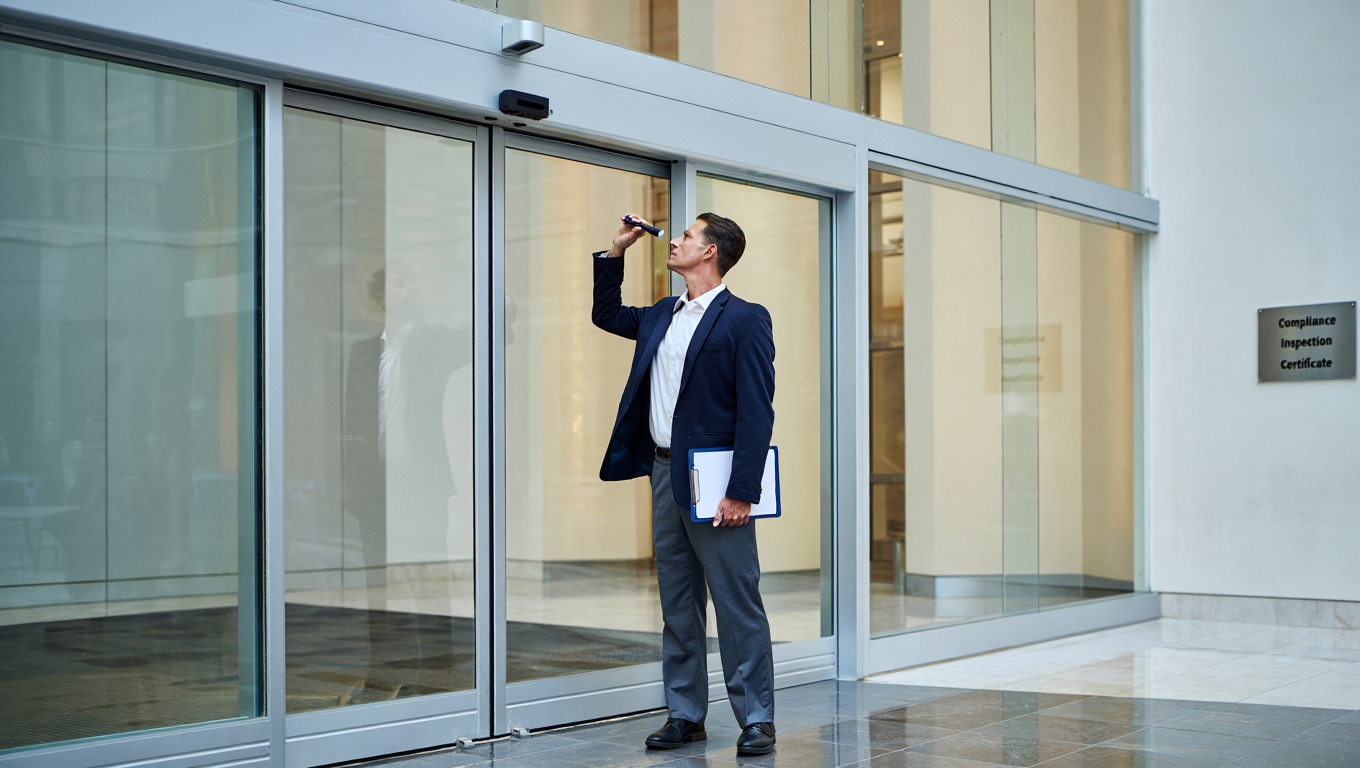
If a property has automatic pedestrian doors, AAADM is one of the strongest reference points in the industry. AAADM recommends that automatic doors be inspected immediately following installation and annually thereafter by AAADM-certified inspectors, with daily safety checks performed by premise owners. The associated ANSI standards define guidelines for installation, sensing devices, and safety requirements for automatic pedestrian doors.
That matters because many building teams assume compliance is only about whether a door appears to work. It is not. Inspection readiness is tied to the actual operating condition of the entrance, the way it has been maintained, and whether the property has allowed small issues to accumulate into a bigger standards problem.
For a deeper look at what AAADM inspection requirements cover in practice, the blog post on AAADM inspection requirements for automatic doors is worth reading before scheduling a service visit.
Why AAADM-related support matters on real properties
- It gives automatic door safety a recognized industry framework
- It helps owners avoid waiting until an entrance is obviously failing
- It supports better documentation and more responsible maintenance planning
- It gives facilities teams a clearer basis for repair, modernization, or inspection scheduling
See the full AAADM inspections page or contact the team to discuss your property’s inspection status.
Accessibility Is Part of Entrance Compliance, Not a Separate Conversation
A commercial entrance can feel secure, polished, and mostly fine while still being a poor experience for the people expected to use it. That is why accessibility cannot be treated like a side issue. The ADA Access Board states that the 2010 ADA Standards set minimum requirements for newly designed and altered state and local government facilities, public accommodations, and commercial facilities to be readily accessible to and usable by individuals with disabilities.
That language matters. Readily accessible and usable is a higher bar than technically operable. A door that works in a minimal sense but creates friction, risk, or inconsistency for someone relying on it is not meeting the intent of that standard.
| Compliance Area | Why It Matters | Typical Next Step |
|---|---|---|
| Automatic door inspection readiness | Doors that are not being checked and maintained properly can fall out of safe operating condition without obvious warning | AAADM inspection support |
| Accessible entry performance | Public-facing and commercial facilities need entrances that remain readily usable, not just technically operable | Review entrance condition, activation, and access behavior |
| Worn or outdated hardware | Aging systems often create risk slowly through inconsistent behavior, poor timing, or recurring failures | Maintenance or modernization |
| Controlled entry coordination | Entrances with access control can create compliance and usability issues when security logic and automatic door behavior are poorly aligned | Review full entry system coordination with a certified technician |
External references: AAADM and the ADA Access Board.
When Commercial Entrance Safety and Compliance Usually Leads to Action
Most owners do not go looking for this service because they woke up excited about standards. They usually get here because something at the entrance is already telling them the building is getting too close to the line. Maybe the door has started acting inconsistently. Maybe an inspection is coming. Maybe the property has recurring complaints. Maybe a facilities team knows the system has not been looked at properly in too long. That is typically the moment when compliance moves from theory to reality.
Common triggers that usually mean the entrance needs attention
- The automatic door has not been professionally evaluated in too long
- The entrance is showing repeat operational issues or awkward behavior
- The building is preparing for inspection, renovation, or a broader safety review
- Controlled openings do not feel smooth or well coordinated
- The property has multiple entrances and no clear condition oversight
- Facilities teams suspect the doorway is technically functioning but not truly in good shape
The blog post on why automatic door certification matters covers the reasoning behind proactive compliance in more depth.
If the building already has a known active problem, emergency automatic door repair may be the right first call.
Compliance Support Usually Connects to Maintenance, Repair, Modernization, and Installation
On real buildings, safety and compliance usually sit in the middle of several connected service decisions.
Maintenance
The cleanest way to stay ahead of entrance risk is to avoid letting the system drift into poor condition in the first place. See automatic door maintenance.
Repair
Some compliance concerns are direct operational failures that need to be corrected right away before anything else. See storefront door repair.
Modernization
If the entrance is outdated, inconsistent, or increasingly hard to support, modernization may be the smarter long-term move. See automatic door modernization.
Installation
Some openings are past the point where incremental correction makes sense and need a cleaner system path altogether. See automatic door installation.
AAADM Inspections
Inspection readiness is part of responsible entrance management for any property with automatic pedestrian doors. See AAADM inspections.
Portfolio Oversight
Multi-site owners often need a cleaner way to understand which properties need attention now. See multi-site commercial door services.
Commercial Entrance Safety and Compliance in Westbury With Support Across New York and New Jersey
Door Automation is based in Westbury and supports commercial properties across New York and New Jersey that need a better handle on entrance condition, inspection readiness, and day-to-day operating risk. For some buildings, that means addressing one problematic opening. For others, it means taking a more serious look at several entrances, a portfolio-wide pattern, or an entry setup that has slowly drifted out of alignment with how the building should operate.
The real value here is not compliance language. It is practical building control. It is knowing whether entrances are being maintained responsibly, whether inspections are being approached seriously, and whether the building is relying on doors that only seem fine because no one has looked closely enough yet.
To get started, contact the team directly to discuss your property’s entrances and what kind of support makes the most sense.
Commercial Entrance Safety and Compliance FAQs
Quick answers for owners, property managers, and facilities teams dealing with commercial entrance safety and inspection concerns in New York and New Jersey.
What does commercial entrance safety and compliance include?
It typically includes evaluating automatic door condition, inspection readiness, maintenance gaps, accessibility-related concerns, and whether the entrance is operating the way a commercial property should be comfortable relying on day to day.
Do automatic doors need annual inspection?
AAADM recommends that automatic doors be inspected immediately following installation and annually thereafter by AAADM-certified inspectors. Premise owners are also expected to perform daily safety checks as part of routine operations.
How does the ADA connect to entrance compliance?
The ADA Access Board states that the 2010 ADA Standards set minimum accessibility requirements for newly designed and altered public accommodations and commercial facilities. That means entrance usability and accessibility are part of a building’s compliance obligations, not a separate issue to address later.
What if the entrance technically works but still feels off?
That is exactly where compliance-related support is useful. A door can operate in a basic sense while being overdue for maintenance, repair, inspection, or modernization. If the behavior feels inconsistent, rough, or unreliable, it is worth having a certified technician evaluate the full system rather than waiting for an obvious failure.
Does Door Automation serve properties outside of Long Island?
Yes. Door Automation is based in Westbury, NY and serves commercial properties across New York City, Long Island, and New Jersey. Properties in all three areas can request support for inspection readiness, maintenance, repair, and related entrance services.
How do I know if my building needs a compliance review or just a repair?
If the entrance has a single identifiable problem, a repair visit may be the right starting point. If the system has not been professionally evaluated in an extended period, has a history of recurring issues, or is approaching an inspection, a broader compliance-oriented review is typically the better first step. The team can help you determine which path makes sense for your property after an initial conversation.
Need a Clearer Picture of Entrance Risk at Your Property?
If your building has automatic door concerns, inspection questions, or entrances that do not feel as reliable as they should, now is the right time to get ahead of it.