

AAADM Inspections for Automatic Doors in NY & NJ
AAADM inspections in New York and New Jersey help commercial property owners verify that automatic doors operate safely, predictably, and in alignment with recognized industry standards. Door Automation performs professional inspection services that reduce liability, support compliance documentation, and give building owners a clearer picture of entrance condition across their properties.
Related services: Automatic Door Maintenance, Service Contracts, and Commercial Entrance Safety and Compliance.
What Is an AAADM Inspection?
An AAADM inspection evaluates whether automatic doors are operating in accordance with recognized safety expectations for pedestrian use. The inspection focuses on sensor performance, opening and closing speeds, activation zones, signage, hold-open timing, closing force, and overall system behavior under real conditions.
AAADM, the American Association of Automatic Door Manufacturers, publishes the standards that define how automatic pedestrian doors should perform. AAADM states that automatic doors should be properly installed, inspected by AAADM-certified inspectors immediately following installation and annually thereafter, and safety-checked daily by premise owners. AAADM's associated ANSI standards define guidelines for installation, sensing devices, and safety requirements for automatic pedestrian doors.
While AAADM itself does not enforce laws, its inspection standards are widely referenced by manufacturers, service providers, insurers, and facility managers as a benchmark for safe automatic door operation. For buildings where doors serve the public, the inspection also connects to broader accessibility obligations. The ADA Access Board states that the 2010 ADA Standards set minimum requirements for newly designed and altered public accommodations and commercial facilities to be readily accessible to and usable by individuals with disabilities -- which means entrance usability is part of a building's compliance picture, not a separate afterthought.
Our inspection procedures align with guidance published by AAADM and the ADA Access Board. AAADM inspections are often performed alongside routine automatic door maintenance to confirm safe operation and address issues before they become failures.
For a detailed breakdown of what inspection requirements cover in practice, the blog post on AAADM inspection requirements for automatic doors covers the key points before you schedule a visit.

What Our AAADM Inspections Include
Each inspection evaluates the automatic door system against recognized safety and performance standards. Here is what the process covers.
Sensor and Activation Testing
- Motion and presence sensor function
- Activation zone coverage and positioning
- False activation risk assessment
- Sensor response under varied approach conditions
Door Movement and Speed
- Opening and closing speed measurement
- Hold-open timing review
- Controlled closing force evaluation
- Smoothness and consistency of operation
Safety and Documentation
- Signage and warning label review
- Operator and hardware condition check
- Inspection records and documentation
- Findings summary for the building file

Who Should Schedule AAADM Inspections?
AAADM inspections are recommended for any commercial property where automatic doors serve daily pedestrian traffic. The standard applies broadly because the safety and usability risk applies broadly -- a door that is not operating correctly creates real exposure regardless of what kind of building it is serving.
Properties that most commonly need regular inspection include:
- Retail stores, shopping centers, and high-traffic storefronts
- Hospitals, medical offices, and healthcare facilities
- Office buildings, corporate campuses, and professional facilities
- Educational institutions, municipal buildings, and government properties
- Multi-tenant and managed residential or mixed-use properties
- Hotels, hospitality venues, and food service locations
Many clients bundle inspections into automatic door service contracts to simplify scheduling and keep compliance documentation current without having to manage the timing separately each year.
If you are unsure whether your property is overdue, the blog post on how often automatic doors should be inspected covers the factors that affect inspection frequency for different types of commercial properties.
What Happens When an AAADM Inspection Identifies a Problem?
An inspection is not just a pass/fail event. When issues are found, the value is in knowing specifically what is wrong and what the right response is. Some findings call for immediate repair. Others indicate a component that is wearing and needs to be monitored or scheduled for replacement. Some point to a configuration issue that can be corrected on the spot during the visit.
The table below shows how common findings typically map to a next step.
| Finding Type | What It Usually Means | Typical Next Step |
|---|---|---|
| Sensor out of alignment or underperforming | Activation zones are not covering the approach correctly, creating a safety gap | Adjustment or sensor replacement |
| Opening or closing speed out of range | Door is moving too fast or too slow relative to safe operating standards | Operator reconfiguration or service call |
| Worn or aging hardware | Components are functioning but showing signs of degradation that will affect reliability | Scheduled maintenance or parts replacement |
| System significantly outdated | Equipment is past useful life and creating ongoing performance and safety risk | Modernization evaluation |
| Missing or damaged signage | Required safety warnings are absent, damaged, or incorrectly positioned | Signage correction during or after inspection |
If the inspection reveals a more urgent operational issue, emergency automatic door repair is available for situations that cannot wait for a scheduled service call.
AAADM Inspections Apply to All Major Automatic Door Types
The inspection standards developed around automatic pedestrian doors are not limited to one style of entry. Commercial properties use a range of door types, and inspection requirements follow the equipment wherever it is in use. Door Automation performs AAADM inspections across all of the following systems:
- Automatic sliding doors in retail, healthcare, and high-traffic commercial settings
- Automatic swinging doors in office buildings, medical facilities, and institutional properties
- Revolving doors in hotels, corporate lobbies, and urban commercial buildings
- Balanced doors in high-wind or architecturally demanding environments
- Low-energy and assisted manual door systems where applicable
If your property has multiple door types or locations, inspection scheduling can be coordinated across all of them through a service contract or as part of multi-site commercial door services.
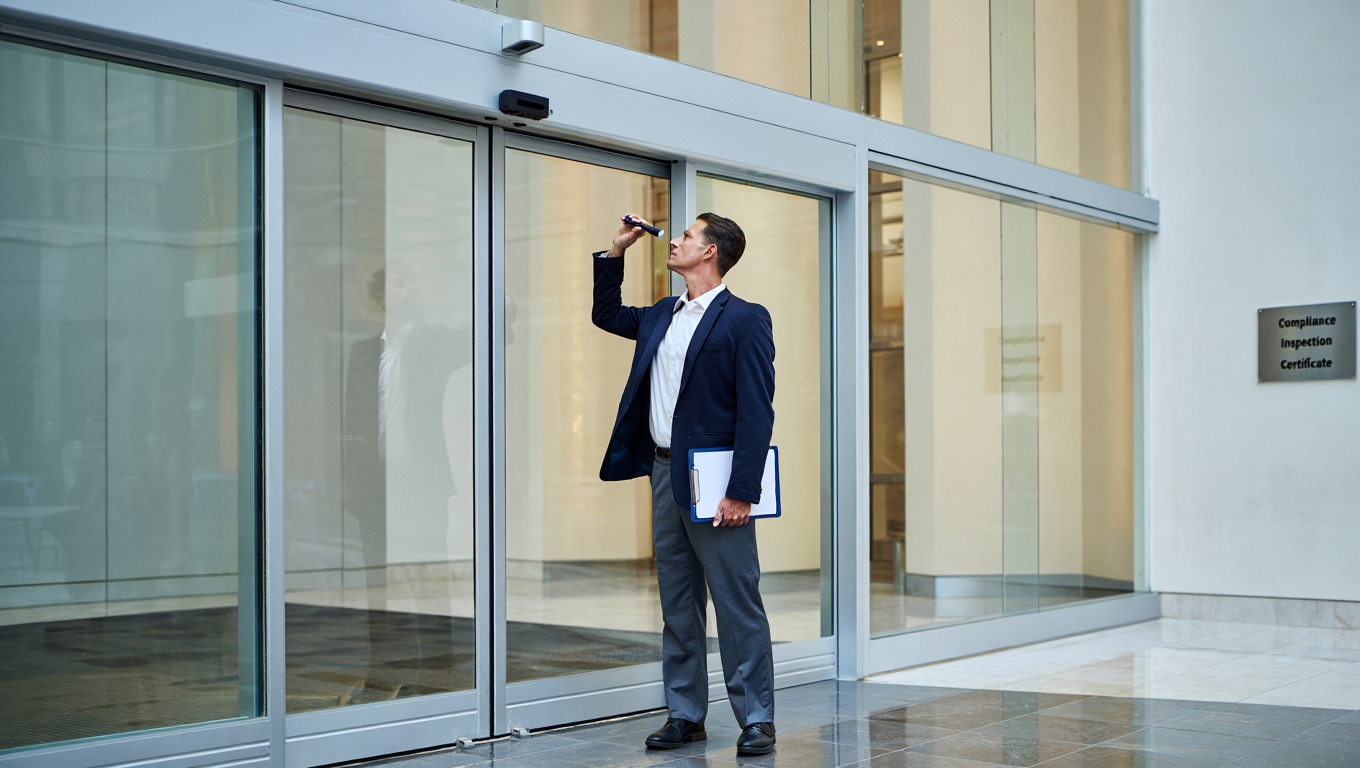
AAADM Inspections in Westbury With Coverage Across New York and New Jersey
Door Automation is based in Westbury and serves commercial properties across New York City, Long Island, and New Jersey. For properties in all three areas, AAADM inspection services can be scheduled directly or bundled into an ongoing service arrangement that keeps documentation current year over year.
Inspection is one part of a broader picture. Properties that treat inspection as part of a regular service rhythm rather than a one-time event tend to have fewer surprise failures, better documentation when it matters, and a cleaner overall handle on entrance condition. For more on how that connects to day-to-day entrance management, see the commercial entrance safety and compliance page or contact the team to discuss your property.
AAADM Inspection FAQs
Common questions from commercial property owners and facilities managers about automatic door inspections in New York and New Jersey.
How often should AAADM inspections be performed?
AAADM recommends that automatic doors be inspected immediately following installation and annually thereafter by AAADM-certified inspectors. Premise owners are also expected to perform daily safety checks as part of routine operations. High-traffic or high-risk environments may warrant more frequent professional review.
Does an AAADM inspection certify my doors?
AAADM inspections document door performance at the time of inspection and provide a record that the system was evaluated against recognized standards. They support compliance efforts and can be useful in liability situations, but they do not replace manufacturer-specific requirements or local building codes.
Can problems found during inspection be corrected?
Yes. If issues are identified during the inspection, the findings are documented and used to determine the appropriate next step -- whether that is an on-the-spot adjustment, a scheduled repair, a parts replacement, or a broader modernization evaluation depending on what the system needs.
Which door types do AAADM inspections apply to?
Inspections apply to automatic sliding, swinging, revolving, and balanced door systems, as well as many low-energy and assisted manual door configurations. If you are unsure whether your specific door type is covered, the team can confirm during the initial conversation.
Can inspections be bundled with ongoing maintenance service?
Yes, and most properties find this easier to manage. Bundling inspections into a service contract means the scheduling is handled automatically and the documentation stays current without requiring a separate reminder or coordination effort each year. The service contracts page has more detail on how that works.
Does Door Automation serve properties outside of Long Island?
Yes. Door Automation is based in Westbury, NY and performs AAADM inspections for commercial properties across New York City, Long Island, and New Jersey. Multi-location portfolios can also coordinate inspections across all sites through a single service arrangement.
Ready to Schedule an AAADM Inspection?
If your automatic doors have not been professionally inspected recently, or if an inspection is coming up and you want a certified technician to prepare the documentation, contact the team to get it scheduled.