

Revolving Door Service & Repair
Revolving door repair in New York and New Jersey helps commercial buildings keep high-traffic lobby entrances safe, smooth, secure, and comfortable. Door Automation Corporation services manual, power-assist, and automatic revolving doors for office buildings, hotels, healthcare facilities, retail properties, mixed-use buildings, transit-related spaces, and managed commercial entrances that need reliable performance every day.
For urgent revolving door problems involving unsafe movement, binding, dragging, broken glass, failed locking, stopped rotation, or a blocked entrance, emergency automatic door repair is available.
Revolving Door Repair for High-Traffic Commercial Entrances
Revolving doors are built to manage steady pedestrian traffic while helping control drafts, energy loss, lobby comfort, and building security. When they work correctly, they feel natural. People enter, pass through, and move on without thinking about the equipment. When they start dragging, speeding up, slowing down, binding, shaking, stopping, or making noise, the entrance becomes a safety concern and an operational problem fast.
Door Automation services revolving doors by looking at the full entrance system. Rotation behavior, controls, sensors, wings, glass, rails, locks, pivots, drive systems, weather seals, floor conditions, and user safety devices all affect performance. A quick adjustment may not fix the real issue if the door is out of alignment, the drive system is wearing down, or the safety devices are not responding consistently.
Revolving door repair for automatic, manual, and power-assist systems
- Automatic revolving door repair for drive systems, controls, activation behavior, braking, sensors, and rotation problems
- Manual revolving door service for dragging, hard pushing, alignment problems, glass damage, hardware wear, and locking issues
- Power-assist revolving door service for inconsistent assistance, resistance, speed concerns, and user comfort problems
- Safety and sensor checks for monitored compartments, edge protection, emergency stop behavior, and user detection
- Locking and security support for shaft locks, wing locks, electric locks, after-hours securing, and access control coordination
Door Automation also services automatic sliding doors, swinging doors, balanced doors, and manual commercial doors for buildings with multiple entrance systems.
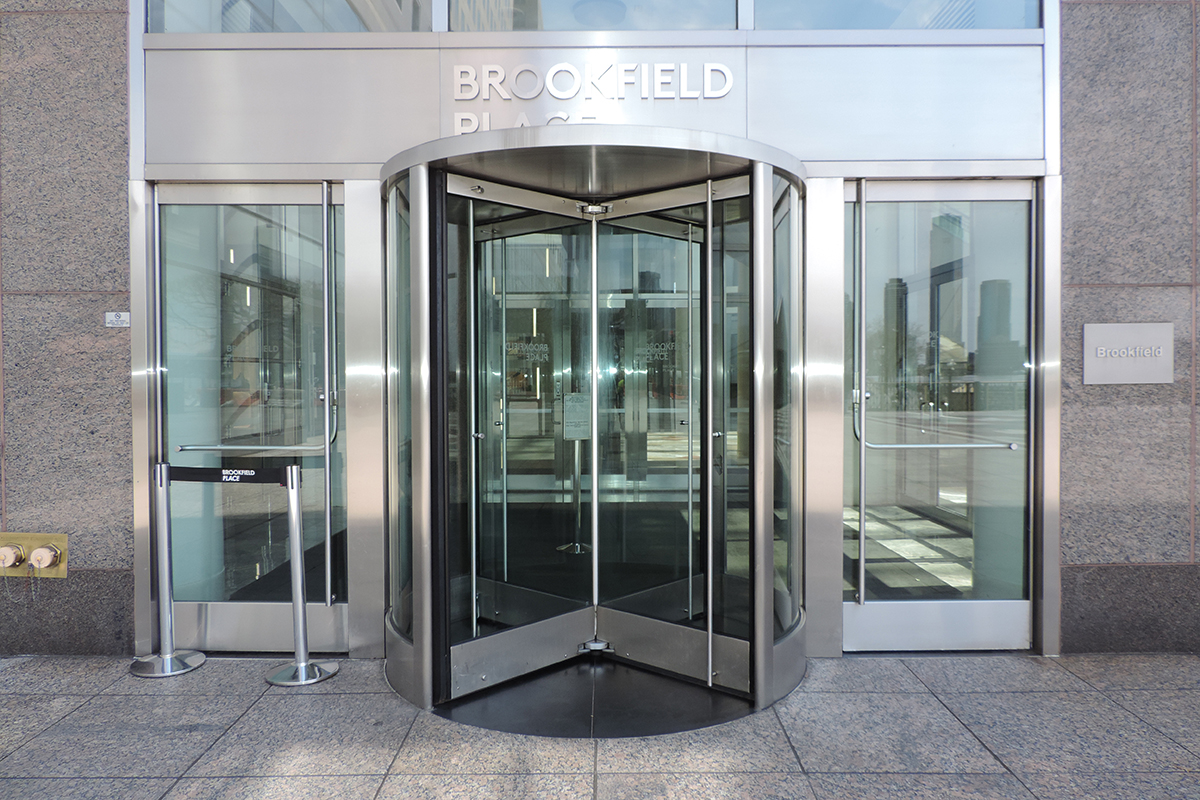
Common Revolving Door Problems That Need Professional Service
Revolving doors should rotate smoothly, respond predictably, and feel controlled for every user. If people start hesitating before entering, forcing the wings, avoiding the entrance, or reporting sudden stops, the system should be inspected before the problem becomes more expensive or unsafe.
Revolving Door Repair Warning Signs
Dragging, grinding, uneven rotation, shaking, sudden stopping, heavy pushing, delayed movement, inconsistent speed, and unusual noise all point to problems that should be diagnosed before component damage spreads.
Doors That Bind, Rub, or Resist Movement
Binding can be caused by floor conditions, worn pivots, wing alignment, damaged weather seals, loose hardware, glass movement, or issues inside the drive and control system.
Automatic Rotation Problems
Automatic revolving doors may stop, surge, hesitate, rotate inconsistently, or respond poorly when sensors, controls, braking, drive parts, or safety devices are out of condition.
Safety Sensor and Emergency Stop Issues
Safety devices are critical on automatic and power-assist revolving doors. Faulty sensors, inconsistent detection, or unreliable emergency stop behavior should be treated as urgent service concerns.
Locking and After-Hours Security Problems
Wing locks, shaft locks, electric locks, access control equipment, and manual securing hardware need to work cleanly so the building can be secured without forcing or improvising.
Drafts, Air Leakage, and Comfort Complaints
Worn seals, misalignment, damaged wings, or poor rotation behavior can reduce the energy and comfort benefits that revolving doors are supposed to provide.
Facility teams comparing repair timing can also use how to know when an automatic door needs repair and automatic door repair versus replacement for practical planning guidance.
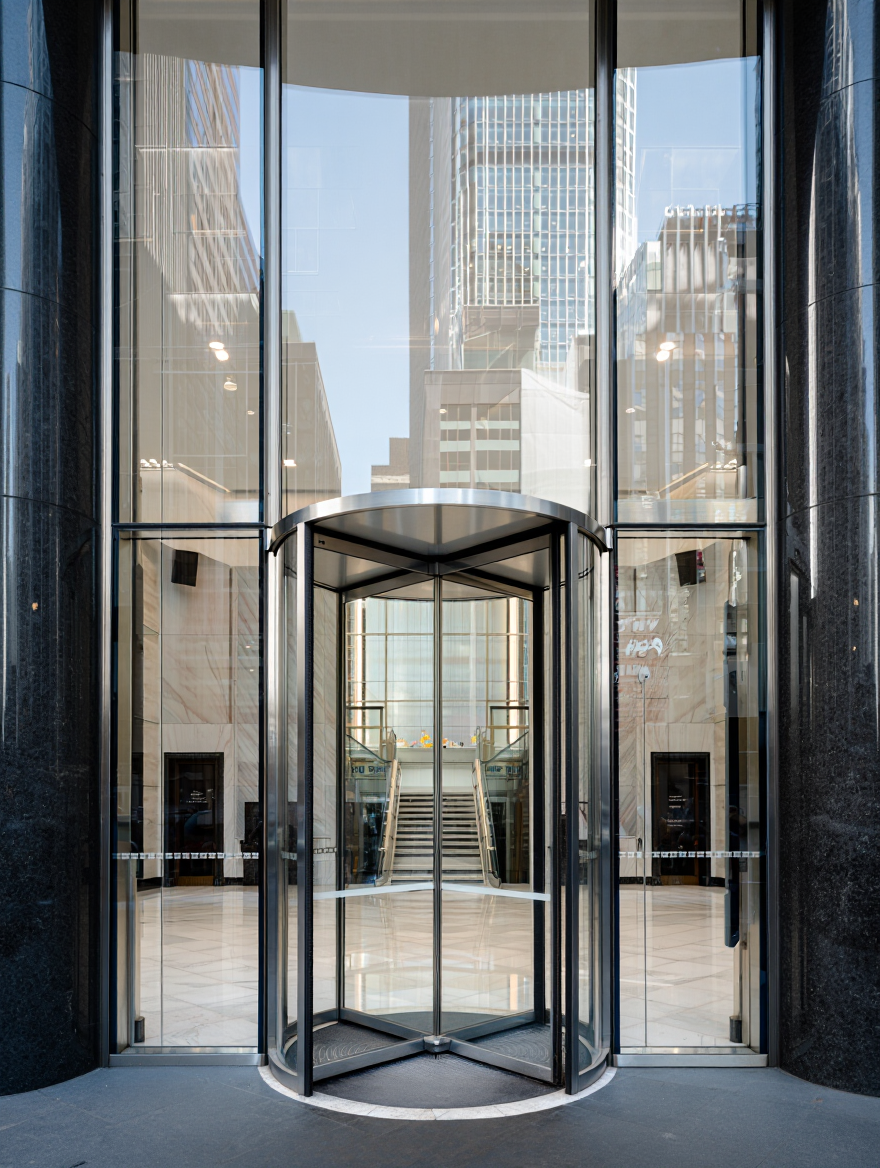
Automatic Revolving Door Service, Sensors, Controls, and Drive Systems
Automatic revolving doors are more complex than standard manual entrances. The door must rotate at a controlled speed, respond to people entering and exiting, monitor user position, stop when needed, unlock correctly, and return to normal operation without unpredictable behavior. That level of performance depends on sensors, drive systems, controls, brakes, locks, and door wings all working together.
Automatic revolving door repair includes full system checks
- Drive and motor troubleshooting for doors that stop, surge, hesitate, vibrate, drag, or fail to rotate under normal use
- Control and activation review for inconsistent response, nuisance stops, delayed movement, and unreliable startup behavior
- Safety sensor inspection for compartment monitoring, presence detection, obstruction response, and emergency stop behavior
- Speed and braking evaluation to help the entrance move smoothly without feeling too fast, too heavy, or unpredictable
- Locking and access coordination where revolving doors interact with electric locks, access control systems, building schedules, or security staff procedures
Manual revolving doors
Manual revolving doors still require careful service. If users have to push too hard, the wings do not track cleanly, or the door feels uneven through the rotation, the issue may involve pivots, bearings, hardware, floor conditions, alignment, seals, or worn components.
Power-assist revolving doors
Power-assist systems should reduce effort without making the user feel pulled or rushed. Inconsistent assistance, heavy movement, jerky rotation, or unusual resistance should be checked before the door becomes harder to use.
Parts and component planning
For worn components, replacement hardware, operator-related needs, or difficult-to-source parts, automatic door parts and components support can help property teams understand what the entrance needs.
Service documentation
Documentation helps building teams track recurring issues, support safety expectations, plan maintenance, and decide when repairs are no longer the smartest long-term option.
Revolving Door Maintenance for Safety, Comfort, and Uptime
Revolving doors are often installed in the buildings that can least afford entrance downtime: office towers, hotels, hospitals, retail centers, civic buildings, and high-traffic lobbies. Maintenance helps catch wear, sensor drift, alignment problems, locking concerns, and early drive issues before they become visible failures.
Mechanical Maintenance
Mechanical maintenance may include checking pivots, bearings, wings, rails, glass, seals, floor contact, hardware condition, and clearances that affect the feel and safety of the entrance.
Electrical and Control Maintenance
Automatic and power-assist systems need periodic checks of drive behavior, braking, controls, activation response, safety inputs, lock coordination, and error conditions.
Safety and Documentation
Routine service records help property teams prove that entrance systems are being monitored, adjusted, and maintained rather than ignored until failure.
A structured automatic door maintenance contract is a smart fit for revolving doors in high-traffic lobbies, managed properties, public buildings, hotels, healthcare facilities, and commercial buildings with safety documentation needs.
Revolving Door Systems for Energy, Traffic Flow, and Security
Revolving doors are popular in urban and high-traffic commercial buildings because they help manage air exchange while people continue moving through the entrance. They can reduce drafts, support lobby comfort, improve traffic flow, and create a stronger architectural entrance when matched to the building's daily use.
Benefits of a properly serviced revolving door
- Reduced drafts compared with doors that leave a large opening exposed during every entry
- More controlled pedestrian flow through busy lobbies and public-facing entrances
- Better interior comfort during cold, hot, windy, or high-traffic conditions
- Improved entrance presentation for office towers, hotels, mixed-use properties, and institutional buildings
- Support for security planning through locks, access control coordination, and traffic control options
For additional context, why revolving doors are most popular in cities and energy advantages of revolving doors explain why these entrances remain common in demanding commercial environments.
Safety, Egress, and Inspection Support for Revolving Doors
Revolving doors need to be safe before they are impressive. A revolving entrance that looks good but behaves unpredictably is a liability. Door Automation supports safety-focused service for automatic and manual revolving doors, including inspection readiness, component checks, sensor review, emergency stop behavior, and operational guidance for building teams.
Safety and service items that matter
- User detection for automatic systems that need dependable safety response inside and around the rotating compartments
- Emergency stop behavior for conditions where a user, obstruction, or system fault requires immediate controlled stopping
- Breakout and egress considerations where applicable to the specific door configuration and building requirements
- Lock and security function so the entrance can be secured without damaging the door or creating unsafe workarounds
- Service documentation to support property teams responsible for public-facing entrances
Door Automation provides AAADM inspection support and service aligned with recognized automatic door safety practices. External automatic door safety information is available through AAADM.
Revolving Door Product PDFs and Manufacturer References
These product references can help facility teams, architects, property managers, and building engineers identify common revolving door systems before repair, maintenance, modernization, or replacement planning. Final recommendations should be based on the actual door, building use, safety needs, and entrance condition.
Revolving Door Brochures and Portfolios
Crane 1000 Series References
The Crane 1000 Series is commonly considered when a project needs the function, look, traffic flow, and energy benefits of a revolving door with budget-sensitive planning.
Crane 2000 and 3000 Series References
The Crane 2000 and 3000 Series options are often reviewed when the project needs a stronger balance of appearance, performance, customization, and long-term entrance planning.
Crane 4000 Series and Specification References
The Crane 4000 Series is often reviewed for all-glass revolving door applications where the entrance needs a more open, architectural look. Specification files can help design and facility teams during planning.
Revolving Door Service by Property Type
Revolving doors are often found where entrances need to handle heavy use while preserving building comfort and presentation. The service approach should reflect the property type, traffic level, security requirements, tenant expectations, and downtime tolerance.
Commercial buildings that commonly need revolving door service
- Office towers, commercial lobbies, and tenant entrances
- Hotels, hospitality properties, event spaces, and guest-facing buildings
- Healthcare facilities, medical buildings, and institutional entrances
- Retail centers, mixed-use properties, and public-facing storefront environments
- Transit-related spaces, civic buildings, and high-volume public entrances
- Managed commercial properties and multi-site portfolios
Property-specific support includes automatic door service for office buildings, automatic door service for hospitality properties, automatic door service for healthcare facilities, and automatic door service for property management.
Repair, Maintenance, Modernization, and Replacement Planning
Not every revolving door problem should be treated the same way. Some entrances need a targeted repair. Others need scheduled maintenance, drive system review, replacement parts, safety updates, glazing work, modernization, or a larger replacement conversation. The right recommendation depends on the system condition and how the building uses the entrance.
When revolving door modernization may make sense
- Frequent failures that keep returning after standard adjustments or part replacements
- Obsolete components that make repairs slower, more expensive, or less dependable
- Safety concerns involving unreliable sensor behavior, stopping, braking, or user detection
- Security needs that have changed since the door was originally installed
- Building updates where the entrance needs to match a new lobby standard, traffic pattern, or accessibility requirement
For larger entrance updates, automatic door modernization and commercial automatic door installation can support planning beyond a single repair call.
Revolving Door Repair FAQs
Answers for facility managers, property managers, building engineers, and business owners scheduling revolving door service in New York and New Jersey.
What does revolving door repair include?
Revolving door repair can include drive system troubleshooting, sensor checks, control adjustments, pivot and bearing service, wing alignment, glass and rail review, locking repairs, emergency stop testing, seal replacement, and safety device inspection. The exact repair depends on the door type and the cause of the problem.
Do you repair automatic and manual revolving doors?
Yes. Door Automation services manual, power-assist, and automatic revolving doors. Service can include mechanical repairs, operator troubleshooting, safety sensor review, locking support, alignment correction, and preventive maintenance.
Why is my revolving door hard to push or dragging?
A hard-to-push or dragging revolving door may have worn pivots, bearing issues, alignment problems, floor contact, damaged seals, loose hardware, damaged wings, or drive-related resistance on power-assist and automatic systems. A proper inspection is needed to confirm the real cause.
Can revolving doors help with building comfort and energy control?
Yes. A properly operating revolving door can reduce drafts and help control air exchange compared with entrances that open a large doorway repeatedly. The energy and comfort benefit depends on door condition, seals, rotation behavior, traffic level, and the building layout.
How often should revolving doors be maintained?
Many commercial revolving doors should be inspected at least once or twice per year, with high-traffic entrances often needing more frequent service. Traffic volume, safety requirements, weather exposure, building use, and past repair history should guide the maintenance schedule.
When should a revolving door be modernized or replaced?
Modernization or replacement may make sense when the door has repeated failures, obsolete components, unreliable safety behavior, difficult-to-source parts, major glass or structural damage, or performance that no longer fits the building's traffic, security, or accessibility needs.
Need Revolving Door Service Scheduled?
Request service for manual, power-assist, and automatic revolving doors, including sensors, controls, drive systems, locks, pivots, glass, safety devices, and high-traffic entrance maintenance across New York and New Jersey.