


Walk into any busy New York storefront, clinic or office lobby and the entrance is doing a lot of quiet work. The advantages of sliding doors for business go well beyond convenience: they welcome every customer, keep traffic moving, trim energy waste and support compliance, all without anyone touching a handle. For owners and property managers across New York, an automatic sliding entrance is one of the few upgrades that improves the customer experience and the operating budget at the same time.
Sliding doors suit entrances where space is limited, traffic is heavy and a wide, unobstructed opening matters. Because the panels move parallel to the wall instead of swinging into the walkway, they work in tight vestibules and crowded sidewalks where a swing door would be awkward or even unsafe.
Advantages of Sliding Doors for Business in New York
The benefits of an automatic sliding entrance fall into a handful of practical categories, and each one translates into something a business owner can measure.
- Accessibility: hands-free entry for wheelchair users, parents with strollers, older adults and anyone with full hands.
- Customer flow: a wide opening and quick response keep lines from forming at the door.
- Energy control: sensors, timers and good glazing help limit the heated or cooled air that escapes.
- Safety and security: presence sensors protect people at the threshold, and locking modes protect the building after hours.
- Appearance: clean lines and large glass areas show off a storefront or lobby.
Accessible Entry for Every Customer
Accessibility is the first and strongest reason to choose an automatic entrance. More than 1 in 4 U.S. adults have some type of disability, according to the CDC, and the New York City Mayor’s Office for People with Disabilities reports almost one million residents with a disability, about 11 percent of the city’s population. Those are customers, employees and visitors who use your entrance every day.
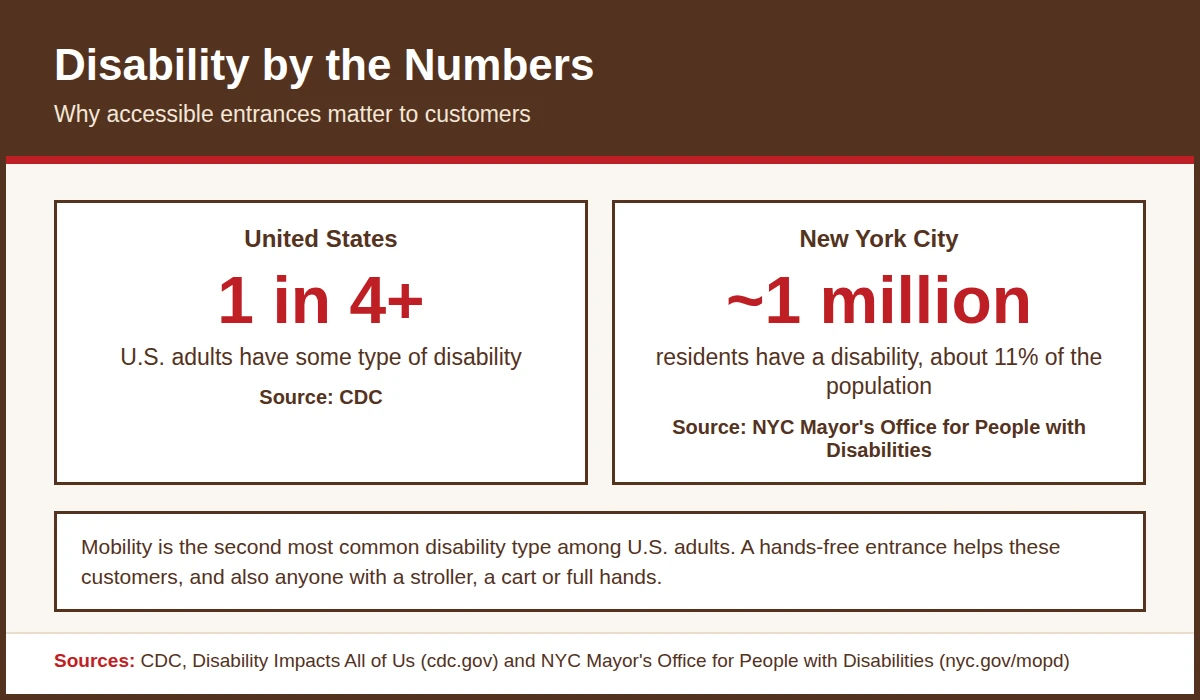
Sources: CDC, Disability Impacts All of Us and NYC Mayor’s Office for People with Disabilities
The benefit reaches far beyond that group. A hands-free door helps anyone pushing a stroller, wheeling a cart or carrying packages, and it removes the small friction of a heavy manual door that many customers will not mention but will remember.
ADA Requirements and Automatic Sliding Doors
The ADA does not require every entrance to be automatic, but it does set rules for the automatic doors that are installed. The ADA Accessibility Standards require full-powered automatic doors to comply with ANSI/BHMA A156.10 and require the doorway to provide a clear opening of at least 32 inches in both power-on and power-off modes.
Manual doors face limits too. The standards cap the opening force for interior hinged, sliding and folding doors at 5 pounds, and heavy doors or strong closers can push a manual entrance past that limit. Designers often turn to automatic doors in exactly that situation, because a power-operated door removes the opening force problem altogether.
Compliance is more than a spec sheet. Clear width, threshold height, sensor coverage and signage all have to be right at installation and stay right over time, which is why commercial entrance safety and compliance requirements belong in the planning conversation from the start.
Tax Incentives for Accessibility Upgrades
Improving access can also be financially smart. Two federal incentives are designed to offset the cost: the Disabled Access Credit for qualifying small businesses and a barrier removal deduction available to businesses of any size. Together they can cover a meaningful share of an entrance upgrade.
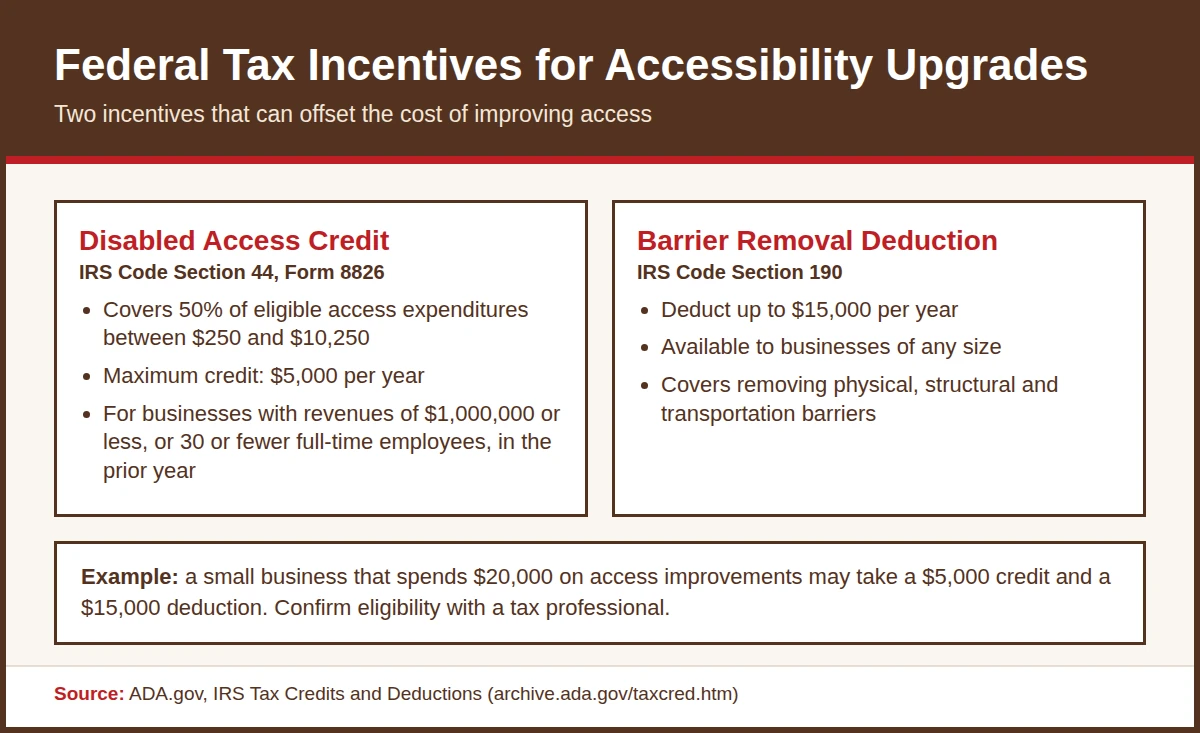
Source: ADA.gov, IRS Tax Credits and Deductions
Eligibility rules apply, and credits generally support improvements to existing facilities, so confirm the details with a tax professional before you rely on either incentive. We are not tax advisors, but the potential savings are worth raising with yours when you budget for an entrance project.
Customer Flow and Experience
Hands-Free Convenience Customers Notice
An automatic door opens as a customer approaches and closes behind them, which means no pushing, no pulling and no wondering which way the door swings. That small convenience shapes a first impression. People remember entrances that feel effortless, and they remember the ones that do not.
Advantages of Sliding Doors for Business at Peak Traffic
A wide sliding opening lets people pass in both directions at once, which is a real advantage at lunchtime in a busy restaurant, during visiting hours at a clinic or on a Saturday in a shopping center. Well-tuned sensors respond quickly without opening for every passerby, so the door keeps pace with the crowd.
Reliable automatic sliding doors matter most when the entrance is busiest. A door that sticks or fails to detect visitors during a rush costs sales and frustrates customers, so the system should be sized and maintained for peak hours, not average ones.
Retail entrances need to balance traffic flow with curb appeal, and dedicated retail entrance door service keeps storefront doors opening smoothly through seasonal rushes.
Medical settings add hygiene and reliability to the list, and healthcare entrance door service supports the doors that patients, families and staff depend on around the clock.
A Stronger First Impression
The entrance is the one part of a business every customer sees. Large glass panels, clean lines and a door that opens at the right moment signal a business that is modern, organized and ready for visitors. For restaurants, boutiques, clinics and offices, that impression starts before anyone says a word.
Where Sliding Doors Fit Best
The advantages of sliding doors for business show up differently depending on the setting, but a few environments benefit the most.
- Retail and restaurants: wide openings for shoppers with bags, strollers and carts, plus a clear view of the interior.
- Healthcare: hands-free entry for patients, wheelchairs and gurneys, with fewer shared touchpoints.
- Offices and lobbies: a smooth, professional entrance that works with access control.
- Hotels and public buildings: reliable, accessible entry for guests with luggage and mobility needs.
Energy Efficiency and Operating Costs
Why Entrances Matter for Energy
Every opening at the front of a building is a place where conditioned air can escape. In New York, where winters are cold, the stakes are higher: the U.S. Energy Information Administration reports that space heating was the largest single energy use in U.S. commercial buildings in 2018, at about 32 percent of consumption, and it was the largest use in every building type charted here.
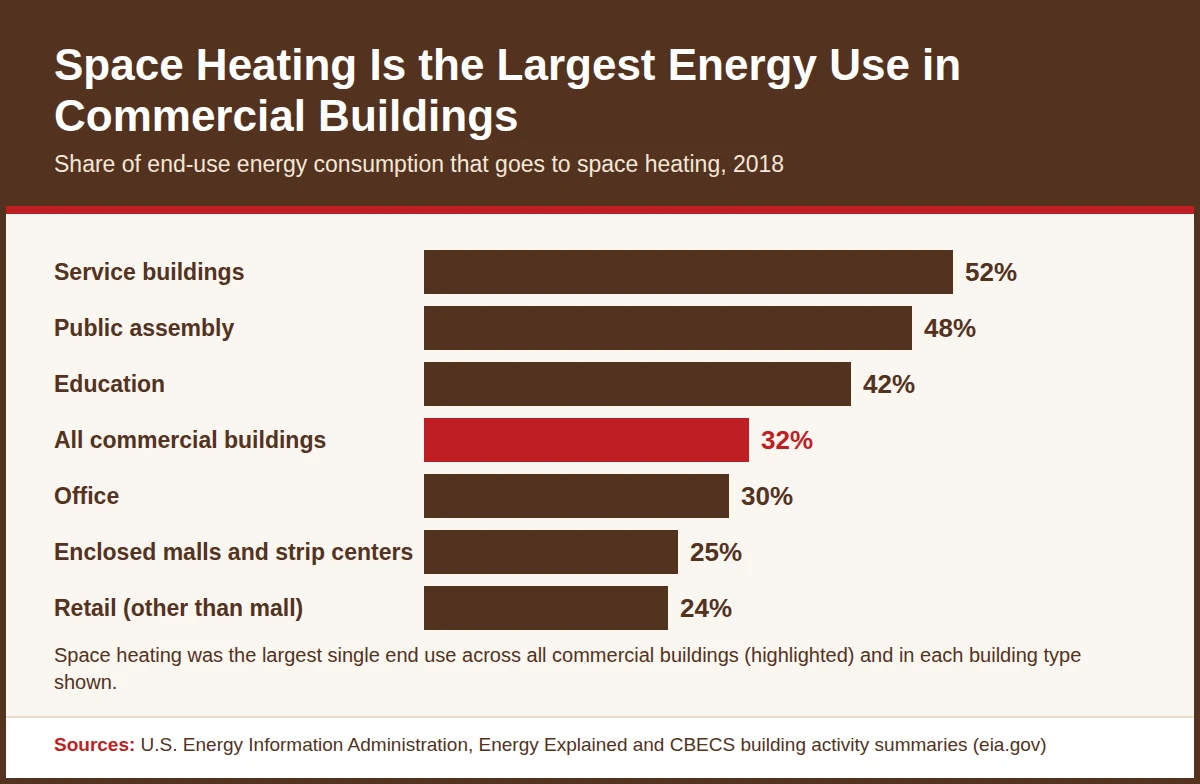
Sources: U.S. Energy Information Administration, Energy Explained and CBECS building activity summaries
An entrance is only one part of a building’s energy picture, but it is one of the few openings used all day long. Controlling how long and how often it stays open is a practical way to protect the heating and cooling you are already paying for.
Features That Cut Waste
- Adaptive sensors: detect direction and speed so the door opens for visitors and ignores passing traffic.
- Adjustable hold-open time: keeps the door from staying open longer than needed, within the limits set by safety standards.
- Insulated and Low-E glass: reduces heat transfer through the largest surface in the entrance.
- Thermally broken frames: interrupt the path of cold through the metal frame.
- Weather seals and brush seals: limit drafts around panels and the threshold.
Older sliding doors often use sensors and controls from another era. Upgrading older automatic door operators with current sensors and programmable controllers can cut nuisance openings and add touchless activation without replacing the whole entrance.
Safety, Security and Reliability
Built-In Safety
Modern sliding doors protect the people who use them. Presence sensors watch the threshold so the panels do not close on someone standing in the doorway, safety beams and side guards protect the leading edge, and the door is tested to stop or reverse when it meets an obstruction. Signage tells visitors the door operates automatically.
Security and Locking Options
Automatic sliding doors can be locked on a schedule, connected to card readers or intercoms and set to different modes during open and closed hours. That lets a business welcome customers freely during the day and secure the entrance at night without changing hardware.
Reliable Operation Day After Day
A sliding door is a working machine with tracks, rollers, belts, sensors and controls, and it performs best with regular attention. A routine of preventive maintenance for automatic doors keeps those parts aligned and lubricated and catches wear before it becomes a failure.
Putting that routine in writing makes it easier to keep. A service contract for automatic doors sets the visit schedule and response expectations in advance, so the entrance stays dependable without anyone having to remember to call.
How to Choose Sliding Doors for Your Business
The right system depends on the width of the opening, the space beside it and the people who use it. Three configurations cover most commercial needs.
| Configuration | How it works | Best fit |
|---|---|---|
| Single slide | One panel slides to one side | Narrower openings or entrances with space on only one side |
| Bi-parting | Two panels open from the center to each side | Most storefronts, lobbies and busy two-way entrances |
| Telescoping | Multiple panels stack behind each other | Wide openings where side wall space is limited |
Match the Door to Traffic and Space
Count how many people use the entrance at its busiest hour, then look at the wall space on each side of the opening. Sliding doors are not the only option, and comparing them with the swing, folding and revolving alternatives among the main automatic door types helps confirm that sliding is the right fit for your entrance.
Materials, Glass and Finishes
Most commercial sliding doors use aluminum frames with safety glass, and the finish, glass tint and coating can be selected for appearance and performance. Low-E coatings improve comfort and energy performance, and a finish that matches the surrounding storefront keeps the entrance looking intentional. Browsing completed commercial entrances is an easy way to compare styles.
Professional Installation Makes the Difference
A sliding door only delivers its advantages when it is installed correctly. The header must carry the operator, the track and floor guide must be true, and sensors must be aimed and tested. Experienced automatic sliding door installation includes a site survey, preparation, mounting and compliance testing so the door performs from the first day.
Working With a New York Sliding Door Specialist
The best results come from a team that treats the entrance as part of how your business runs. Door Automation Corp designs, installs and services automatic sliding, swinging, folding and revolving doors for commercial buildings across New York and New Jersey, and works with owners, architects and property managers to choose and maintain the right system.
If you are planning a new entrance or upgrading an older one, talk with a sliding door specialist about your traffic, your accessibility goals and your budget.
| Request a Sliding Door Consultation |
Advantages of Sliding Doors for Business FAQs
What are the advantages of sliding doors for business?
The main advantages of sliding doors for business are accessible hands-free entry, smooth customer flow, lower energy loss than doors that stay open longer, built-in safety sensors, flexible security and locking modes, and a clean, modern appearance. They also fit tight spaces because the panels slide parallel to the wall instead of swinging into the walkway.
Are automatic sliding doors ADA compliant?
They can be. The ADA Standards require full-powered automatic doors to comply with ANSI/BHMA A156.10 and require the doorway to provide a clear opening of at least 32 inches in both power-on and power-off modes. A qualified installer sets up, tests and documents the door so it meets the applicable requirements.
Do automatic sliding doors save energy?
They can reduce waste when they are specified and set up well. Adaptive sensors prevent nuisance openings, adjustable hold-open times keep the door from staying open longer than necessary, and insulated glass, thermal breaks and weather seals limit heat transfer. Space heating is the largest single energy use in U.S. commercial buildings, so controlling the entrance helps.
Is there a tax credit for installing accessible doors?
Federal incentives may apply. The Disabled Access Credit covers 50 percent of eligible access expenditures between $250 and $10,250 for qualifying small businesses, and the barrier removal deduction allows up to $15,000 per year for businesses of any size. Eligibility rules apply, so confirm the details with a tax professional before you rely on either one.
What types of automatic sliding doors are available?
The most common configurations are single-slide doors, bi-parting doors that open from the center and telescoping doors that stack panels to create a wider opening in limited wall space. Frames and glass can be selected for appearance, durability and energy performance.
How often do automatic sliding doors need service?
Busy entrances benefit from preventive maintenance on a regular schedule, with owners checking the door each day and a trained technician inspecting and adjusting it at least once a year. Doors with heavy traffic or harsh weather exposure may need more frequent visits to keep sensors, tracks and rollers in good condition.