

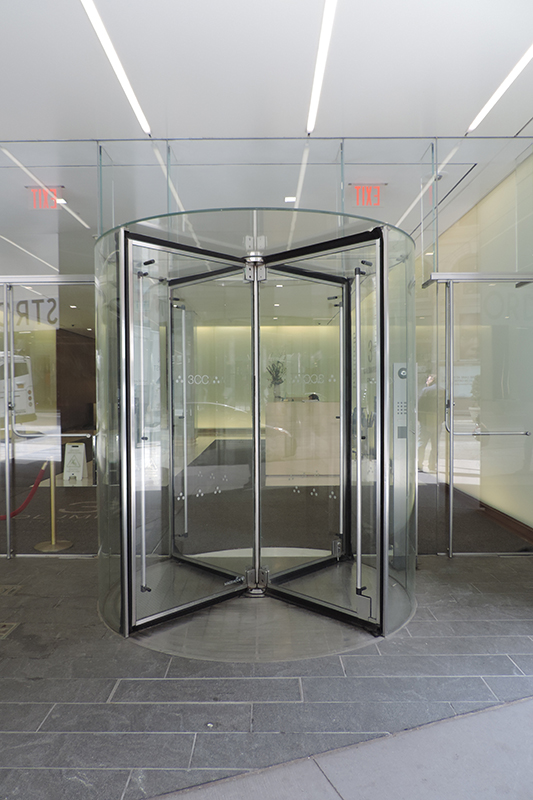
A revolving door is more than an entrance. It is a working piece of the building that moves people, protects the lobby climate and sets the first impression. Choosing the right commercial revolving door for a New York building means balancing traffic, security, accessibility, code requirements and design, and the best decisions are made before any equipment is ordered.
Whether you are planning a hotel entrance in Midtown, an office tower lobby in Lower Manhattan or a secure facility in Long Island City, the same questions apply: what type of door fits the people who use it, what size fits the space and what has to be true for the door to be safe, compliant and easy to maintain?
Choosing a Commercial Revolving Door: Key Factors
Revolving doors sit alongside sliding, swinging and folding systems among the main automatic door types, but they do a particular job. They keep a lobby sealed against wind and weather, move a steady flow of people in both directions and give an entrance architectural presence. Those strengths shape every selection decision.
Manual, Automatic and Security Revolving Doors
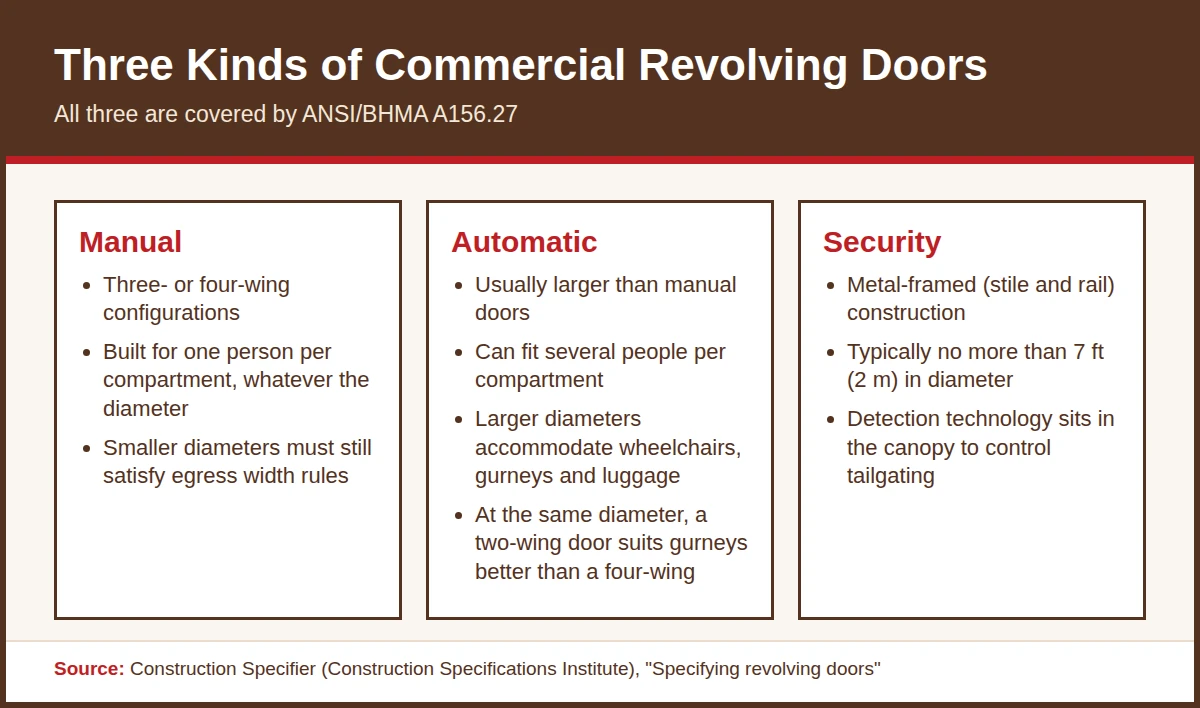
Most commercial revolving doors fall into one of three categories, and all three are covered by ANSI/BHMA A156.27, the standard for power and manual operated revolving pedestrian doors. The category you choose drives size, cost and the way people use the entrance.
Source: Construction Specifier, "Specifying revolving doors"
Manual doors are the simplest and are usually pushed by visitors. Automatic doors rotate under power, slow down or stop when sensors detect a person or object and suit high-traffic lobbies. Security doors add detection technology and are used where tailgating has to be controlled.
Commercial Revolving Door Sizes and Configurations
Size is one of the first questions buyers ask, and it connects directly to the door category. Manual doors are built for one person per compartment, no matter how large the diameter. Automatic doors tend to be larger and can fit several people in each compartment, and as the diameter grows, so does the door’s ability to handle wheelchairs, gurneys and luggage.
- Diameter: manufacturer specifications list nominal diameters from about 6 feet for access-controlled units up to 20 feet for high-capacity automatic models.
- Wing count: two-wing, three-wing and four-wing designs move people differently. At the same diameter, a two-wing door handles large gurneys better than a four-wing door.
- Height and canopy: ceiling height, the canopy and the surrounding enclosure walls all affect how the door fits into the lobby.
- Peak traffic: size the door for the busiest hour, not the average one.
A site survey that measures the floor, ceiling, power and nearby stairs or escalators should confirm the final dimensions before the door is fabricated.
Speed, Capacity and User Experience
Rotation speed is limited by code according to the door’s diameter and type, and automatic doors are programmed to stay within those limits. A faster door moves more people but can feel rushed for older adults, children and visitors with luggage, while a slower door is gentler and uses less energy but can slow traffic during rush hour. A good installer tunes the speed for the people who actually use the entrance and verifies it during testing.
Materials, Finishes and Glass
Revolving doors can be specified in a wide range of materials, which lets the entrance support the building’s design rather than compete with it. Glass panels bring daylight into the lobby, and metal framing gives the door strength and a finished look.
- Glass: safety glazing in clear, tinted or low-emissivity options for daylight and energy performance.
- Metal finishes: anodized aluminum, stainless steel or bronze for durability in high-traffic lobbies.
- Custom details: colors, canopy treatments and enclosure designs that match the architecture.
Browsing the completed entrance projects is a quick way to compare finishes and configurations before committing to a design.
Energy Performance in New York Weather
A revolving door is never fully open, so it limits the exchange of indoor and outdoor air that a swinging door allows every time someone walks through. In a 2006 analysis of a single MIT building, students calculated that a swinging door exchanged as much as eight times more air than a revolving door. That is one building, but it explains why revolving doors are common in cold-winter cities, where every lobby opening costs heat.
Code, Safety and Accessibility Requirements
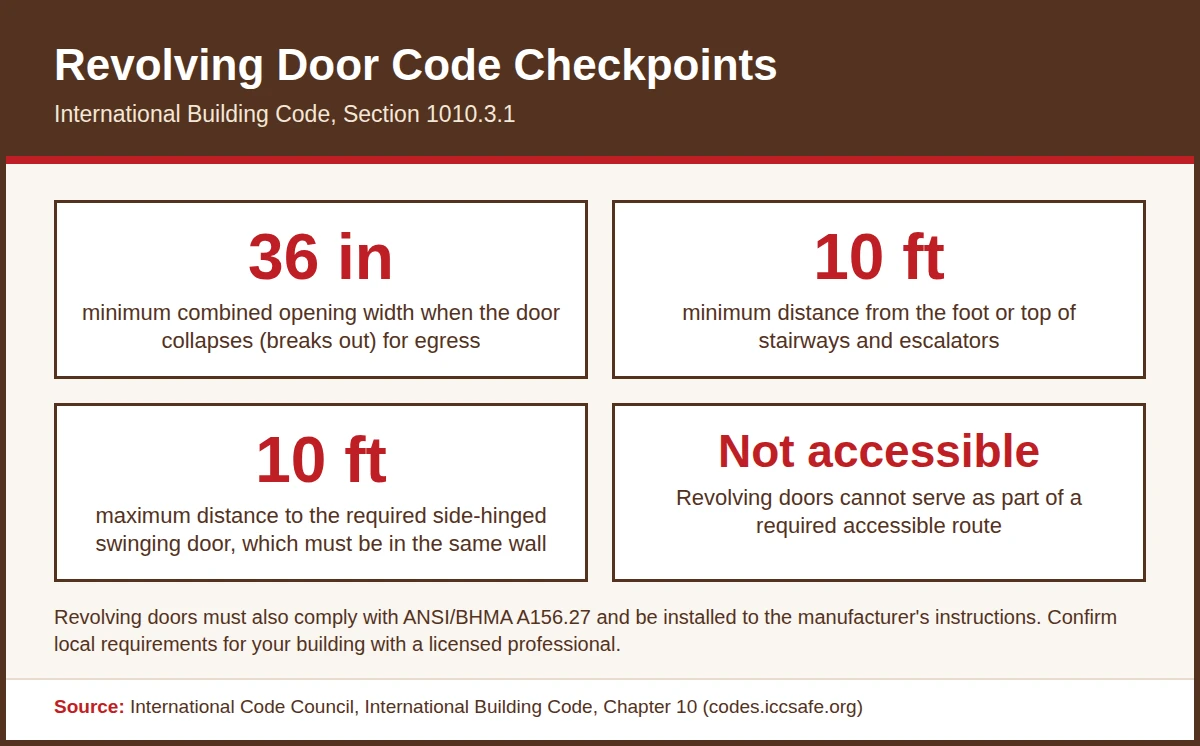
Revolving doors are among the most regulated entrance products because they must also work as part of the building’s emergency egress plan. The checkpoints below come from the International Building Code, the model code that many jurisdictions adapt. New York City applies its own Building Code, so confirm local requirements with a licensed professional.
Revolving Door Code Checkpoints
Source: International Code Council, International Building Code, Chapter 10
The code also requires revolving doors to comply with ANSI/BHMA A156.27 and to be installed according to the manufacturer’s instructions. Under that standard, each wing must collapse when a set force is applied near the outer edge of the wing, which is what allows the door to open into a clear path during an emergency. Power-operated doors also need an emergency stop switch within easy reach at each entry point.
A written checklist of entrance safety and compliance requirements helps design teams, owners and installers confirm each of these items before the door is ordered.
Accessibility and the Adjacent Door
Because a revolving door cannot be part of a required accessible route, every revolving entrance needs an accessible door beside it. Accessibility guidance such as the ADA Accessibility Standards and the building code both expect that separate option, which is also the door visitors with strollers, luggage carts or mobility devices will choose.
Pairing the revolver with a power-operated door makes the accessible path as convenient as the main one. A low-energy automatic swing door beside the revolving door satisfies the swinging door requirement and gives every visitor a hands-free option.
Security and Access Control Options
Revolving doors can control who enters as well as how they enter. Security models use detection technology in the canopy to limit tailgating, and standard automatic doors can connect to card readers, intercoms or credential systems. The right level of control depends on whether the door serves the public, employees or a mix of both.
Safety Features to Expect
- Sensors in the wings and enclosure that stop or slow the door when someone is detected
- Speed control that keeps rotation within the limits set for the door’s diameter
- Breakout wings that collapse for emergency egress
- Required signage on automatic doors, visible from both sides of each wing
Matching a Revolving Door to Your Building
Different buildings value different things at the front door. A hotel wants a grand arrival, an office tower wants security and a calm lobby, and a transit station wants throughput. This table pairs common priorities with the configuration that usually fits.
| Building type | Typical priorities | Configuration to consider |
|---|---|---|
| Hotels | Guest experience, luggage, weather protection | Larger automatic door with an adjacent automatic swing door |
| Office towers | Security, comfort, steady rush-hour flow | Automatic or security revolving door with access control |
| Retail and shopping centers | Traffic flow, appearance, energy | Automatic revolving door flanked by sliding or swing doors |
| Transit and public buildings | Throughput, durability, accessibility | High-capacity automatic door with accessible side doors |
| Secure facilities | Controlled entry, tailgating prevention | Security revolving door with integrated detection |
Hospitality entrances benefit from a door that welcomes guests with luggage and keeps the lobby comfortable, which is the focus of dedicated hotel and hospitality entrance service. Office lobbies add security and rush-hour flow to the list, and office building entrance service keeps those entrances reliable for tenants and visitors alike.
New Lobby or Existing Entrance
New construction gives designers the most freedom to size the door and plan the surrounding walls. An existing lobby is more constrained, but a worn revolving door does not always have to be replaced. When the enclosure is sound, modernizing an existing revolving door entrance with a new drive, controls and safety devices can restore performance and meet current standards.
Planning, Installation and Long-Term Care
What the Site Survey Should Cover
A revolving door is built to a fixed footprint, so the lobby has to be measured carefully. The survey should confirm the floor opening and finish, the ceiling height, the power supply, the distance to stairs and escalators, the location of the adjacent accessible door and the delivery path for the drum and glass.
Professional commercial automatic door installation coordinates those details with the building’s architects, trades and fire protection team so the door goes in once and passes inspection the first time.
| Selection factor | Question to ask | Why it matters |
|---|---|---|
| Traffic | How many people use the entrance at peak? | Sets diameter, wing count and drive capacity |
| Users | Will strollers, luggage or gurneys pass through? | Larger automatic doors handle them more easily |
| Security | Does the door need to control entry? | Determines manual, automatic or security model |
| Code | Where are the stairs and the swinging door? | Distances and breakout rules affect placement |
| Service | Who will maintain it and how often? | Moving parts need scheduled attention |
Maintenance Expectations
A revolving door works like a moving vestibule, with a drive, bearings, seals, sensors and breakout hardware that all need attention. Dedicated revolving door installation and service keeps those components inspected, adjusted and tested so the door stays smooth, quiet and compliant.
A regular program of preventive maintenance for automatic doors catches wear early. When something fails, such as a stuck wing or a sensor fault, emergency door repair gets the entrance moving again with minimal disruption to the lobby.
What Affects Project Cost
Revolving door projects vary widely, and the price follows the scope more than the door itself. Because every lobby is different, a written proposal after a site survey is the only reliable way to compare options.
- Door category and diameter: automatic and security models cost more than manual doors, and larger diameters add fabrication and installation work.
- Glass and finishes: specialty glazing, custom colors and premium metals raise the cost of the enclosure.
- Site preparation: floor openings, ceiling work, power and the adjacent accessible door all belong in the budget.
- Access control integration: readers, detection technology and software add equipment and programming.
- Approvals and service: permits and the ongoing maintenance plan complete the picture.
Common Selection Mistakes
- Sizing for average traffic: a door that is comfortable at noon can back up the lobby at 9 a.m.
- Forgetting the adjacent door: the accessible swinging door is part of the design, not an afterthought.
- Blocking the swinging door: it is common to see the side door blocked to push people toward the revolver, but that is not code-compliant.
- Skipping maintenance planning: moving parts need scheduled attention from the first month.
- Choosing on appearance alone: finishes matter, but traffic, security and code decide whether the door works.
Working With a New York Revolving Door Specialist
The best revolving door projects start with a conversation about how the building actually works. Door Automation Corp surveys, supplies, installs and services revolving, sliding, swinging and folding doors for commercial buildings across New York and New Jersey, and works with architects and property teams to choose the configuration that fits each lobby.
If you are weighing options for a new or existing entrance, talk with a revolving door specialist about your traffic, your design goals and the code requirements your building has to meet.
| Request a Revolving Door Consultation |
Commercial Revolving Door FAQs
How do I choose a commercial revolving door for my building?
Start with traffic volume and the people who use the entrance, then choose the type (manual, automatic or security), the diameter and wing count, the materials and glass, and the access control needs. Confirm code requirements such as breakout width, distance from stairs and an adjacent swinging door, and plan for ongoing maintenance before you order.
What size commercial revolving door do I need?
Size depends on peak traffic and who will use the door. Manual doors are built for one person per compartment regardless of diameter, while larger automatic doors fit several people, wheelchairs, gurneys or luggage. Manufacturer specifications list nominal diameters from about 6 feet to 20 feet depending on the model, and a site survey confirms what the lobby can accommodate.
Are revolving doors ADA compliant?
Revolving doors cannot be part of a required accessible route under the International Building Code, so an accessible side-hinged swinging or sliding door is needed alongside them. Pairing the revolving door with an automatic swing door gives every visitor a barrier-free option.
Does a revolving door need an adjacent swinging door?
Yes. The International Building Code requires each revolving door to have a side-hinged swinging door in the same wall and within 10 feet of the revolving door. Local requirements can differ, so a licensed professional should confirm what applies to your building.
Are revolving doors more energy efficient than swing doors?
Revolving doors limit air exchange because the entrance is never fully open. In a 2006 analysis of one MIT building, students calculated that a swinging door exchanged as much as eight times more air than a revolving door. Actual savings vary with climate, traffic and how often people use each door.
How much maintenance does a commercial revolving door need?
A revolving door works like a moving vestibule, so it has more moving parts than a standard door and benefits from regular preventive maintenance. A technician typically checks the drive, sensors, seals, bearings and safety devices on a set schedule and tests the emergency stop and breakout functions.