

AAADM inspection requirements in New York come from industry standards and owner responsibility rather than a single state law: AAADM recommends that automatic doors be inspected after installation and at least once a year by a certified inspector, with a daily safety check in between. Local codes, insurers, and lease terms can add their own requirements, so building owners should know both what AAADM recommends and what applies to their property.
Quick Answer: AAADM Inspection Requirements for Automatic Doors
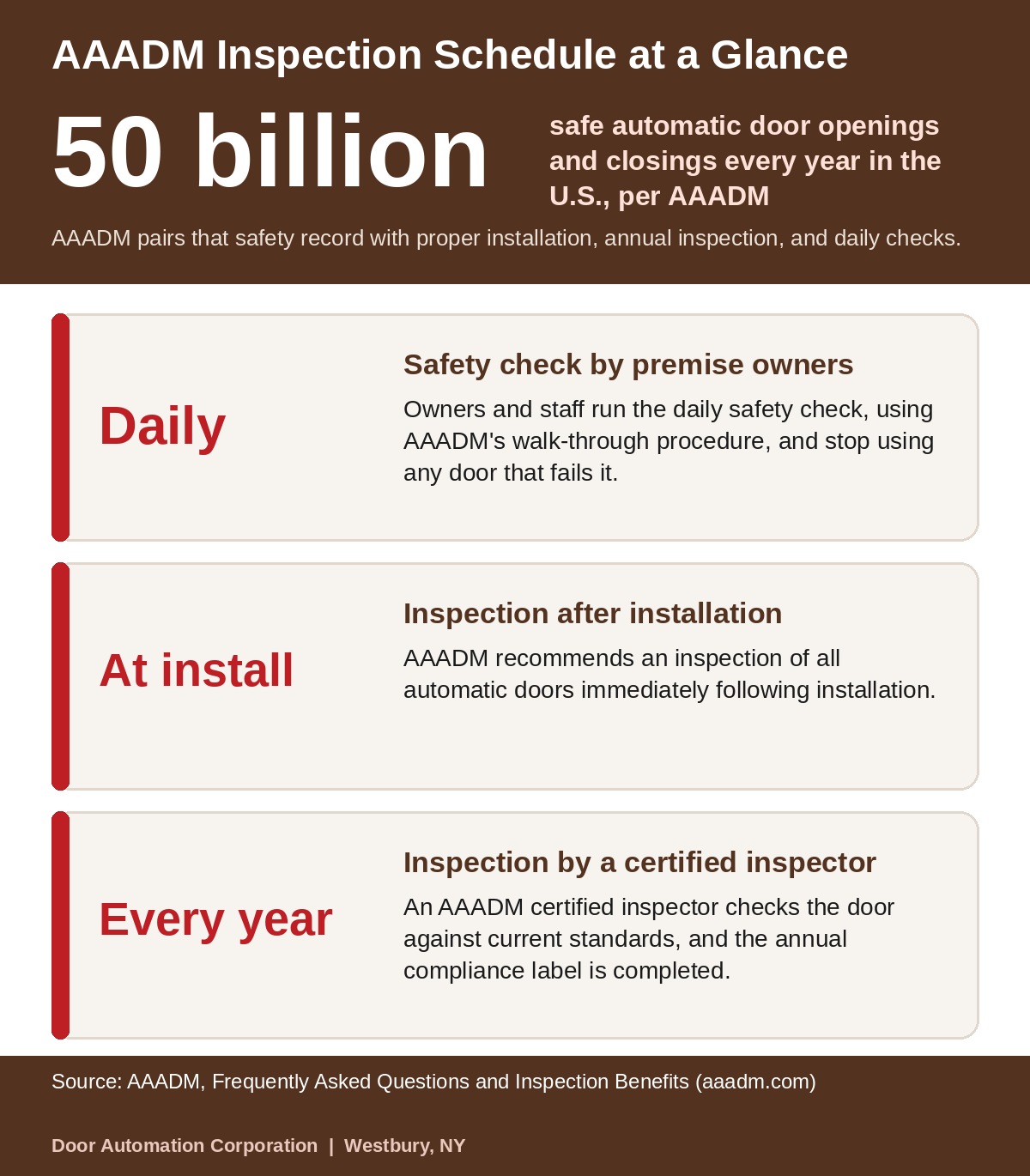
AAADM recommends that automatic doors be inspected right after installation and at least once a year by an AAADM-certified inspector, with a daily safety check by the owner’s staff.
- Who sets the rules: the ANSI/BHMA standards govern the doors, and AAADM trains and certifies the inspectors who test against them.
- How often: after installation, then annually, plus a daily check by staff.
- What you keep: a signed AAADM inspection form or work order and a completed annual compliance label on the door.
- If a door fails: stop using it in automatic mode and call a certified technician.
What AAADM Is and What It Does Not Require
AAADM is a trade association of automatic door manufacturers, founded in 1994, that raises awareness about automatic doors and runs the program that certifies door inspectors.
The American Association of Automatic Door Manufacturers does not write building codes or enforce inspections. Its role is to train inspectors, publish safety guidance, and give owners a consistent way to document that a door was tested.
The Standards Behind AAADM Inspections
The ANSI/BHMA A156 standards define how automatic doors must be built, installed, and made safe, and AAADM-certified inspectors test doors against them.
| Standard | What it covers | Typical doors |
|---|---|---|
| ANSI/BHMA A156.10 | Power-operated pedestrian doors (full energy), including installation, sensing devices, and safety requirements | Sliding, swinging, and folding doors in stores, hospitals, hotels, and airports |
| ANSI/BHMA A156.19 | Low-energy and power-assist swing doors | Accessibility operators and interior swing doors |
| ANSI/BHMA A156.38 | Low-energy power-operated sliding and folding doors | Slower sliding and folding entrances |
The ADA Standards for Accessible Design point to the same documents: full-powered automatic doors must comply with ANSI/BHMA A156.10, and low-energy and power-assist doors with ANSI/BHMA A156.19. That connection is why a door that passes inspection also supports your accessibility obligations.
Are AAADM Inspection Requirements Legally Binding?
AAADM does not write or enforce law, so the inspection itself is a recommended safety practice that insurers, lease terms, or local authorities may turn into a requirement.
In practice, owners often need the inspection record anyway. Insurance representatives, safety auditors, and attorneys may ask for proof that a door was inspected and maintained, and the daily and annual checks are how an owner shows reasonable care. Confirm what your insurer and local authority expect, and treat the AAADM schedule as the baseline.
How Often AAADM Inspections Are Recommended
AAADM recommends an inspection immediately following installation and annually thereafter, with a daily safety check by the premise owner.
| Check | When | Who performs it | What you keep |
|---|---|---|---|
| Daily safety check | Every day the door is in use | Owner or building staff | A simple log of the checks and any faults found |
| Post-installation inspection | Right after a new door is installed | AAADM-certified inspector | Signed inspection form and a completed label on the door |
| Annual inspection | At least once a year | AAADM-certified inspector | Signed inspection form or work order, plus a completed annual compliance label |
| Re-check after service | Each time safety devices are serviced or adjusted | Certified technician | Service record noting what was tested |
AAADM’s minimum is annual. Doors that run all day in a hospital, store, or transit entrance may justify more frequent maintenance visits between inspections, but that is a maintenance decision based on traffic and wear and not an AAADM rule.
What an AAADM Inspection Covers
An AAADM inspection tests whether the door and its safety devices meet the ANSI/BHMA standard that applies to that door.
| Area | What the inspector checks | Why it matters |
|---|---|---|
| Sensors and detection zones | Activation and presence sensors, beam alignment, and coverage of the door path | A door must open for people and must not close on them |
| Speed, force, and timing | Opening and closing speed, hold-open time, and closing force; for low-energy swing doors, AAADM guidance says the force to stop the door from closing should not exceed 15 pounds | Settings drift with wear and are tied to the standard that applies to the door |
| Breakout and emergency features | Breakout panels or switches release as intended and the door does not activate in breakout mode | People need a safe way out if power or the operator fails |
| Signs and labels | Required decals are present, readable, and mounted where users can see them | Users rely on them to know how the door works |
| Hardware and door condition | Panels, pivots, covers, fasteners, and connections between door and operator | Loose or damaged parts cause failures and injuries |
| The area around the door | Trip hazards, displays, racks, or anything that interferes with the door or invites people to stop in the path | Clutter blocks sensors and creates risk |
What the Inspector Leaves You With
After a passing inspection, you should have a signed AAADM inspection form or work order and a completed annual compliance label on the door’s safety information label.
Keep those records with your daily check log. If the door needs repairs to pass, the inspector or technician should document what was found and what was corrected so the next inspection starts from a clear record.
Owner Responsibilities: Daily Safety Check and Paperwork
AAADM places the daily check on the owner: inspect the door every day, and if it fails, do not repair or adjust it yourself.
AAADM’s own owner guidance on liability and signage explains that owners should know their door system, keep it maintained to the standard, and keep signs and labels readable. If a sign is removed or unreadable, request a replacement when you call for service.
AAADM Daily Safety Check Steps
- Walk toward the door at a normal pace; it should open before you reach it.
- Stand still in the path; the door should stay open.
- Step out of the path; the door should close after its hold-open time.
- Check that required signs and decals are present and readable.
- Inspect the door and hardware for damage, and make sure displays or clutter are not in the door area.
- If the door fails any step, stop using it in automatic mode and call a certified technician.
Paperwork Every Owner Should Have on File
AAADM says a door supplier should give owners seven things for each door, and missing items are worth requesting.
- Instructions for the daily safety check, shown by walk-through
- The location of function switches and how to use them
- The circuit breaker or main power disconnect for each door
- An AAADM inspection form or a work order signed by an AAADM-certified inspector
- A completed annual compliance inspection label on the door
- Warranty information
- A number to call for service or questions
AAADM Certification: What It Means for an Inspector
An AAADM-certified inspector has studied the ANSI/BHMA standards, completed a course with hands-on training, and passed an exam on the material.
AAADM describes the value in its guide to the benefits of certified inspectors: certified inspectors understand the latest standards that apply to automatic pedestrian doors, and AAADM also offers a recertification program so that knowledge stays current.
What AAADM Certification Does Not Cover
AAADM certification qualifies a person to inspect and test doors against the standards, but it does not by itself mean the person can install or repair every brand of operator.
Automatic door systems vary by manufacturer and design. Choose a provider that employs certified inspectors and also keeps experienced service technicians, because a company that can both test and repair can fix what the inspection finds without a second vendor visit.
Common AAADM Compliance Mistakes to Avoid
Most compliance gaps come from simple oversights, not from major failures.
- Waiting for a breakdown. Many safety issues develop gradually and only show up in a structured inspection.
- Skipping records. Without a log and the signed inspection form, you cannot show what was checked or when.
- Letting unqualified people adjust the door. Staff can clean and look, but sensor, speed, and force adjustments belong to a certified technician.
- Ignoring signs and labels. Missing or unreadable decals leave users without instructions.
- Cluttering the door area. Displays, racks, and planters block sensors and invite people to stop in the path.
- Forgetting the re-check. Safety devices should be tested again each time the door is serviced.
Why Skipping Inspections Costs More Than Doing Them
Skipped inspections let small faults grow into failures, injuries, and emergency repairs.
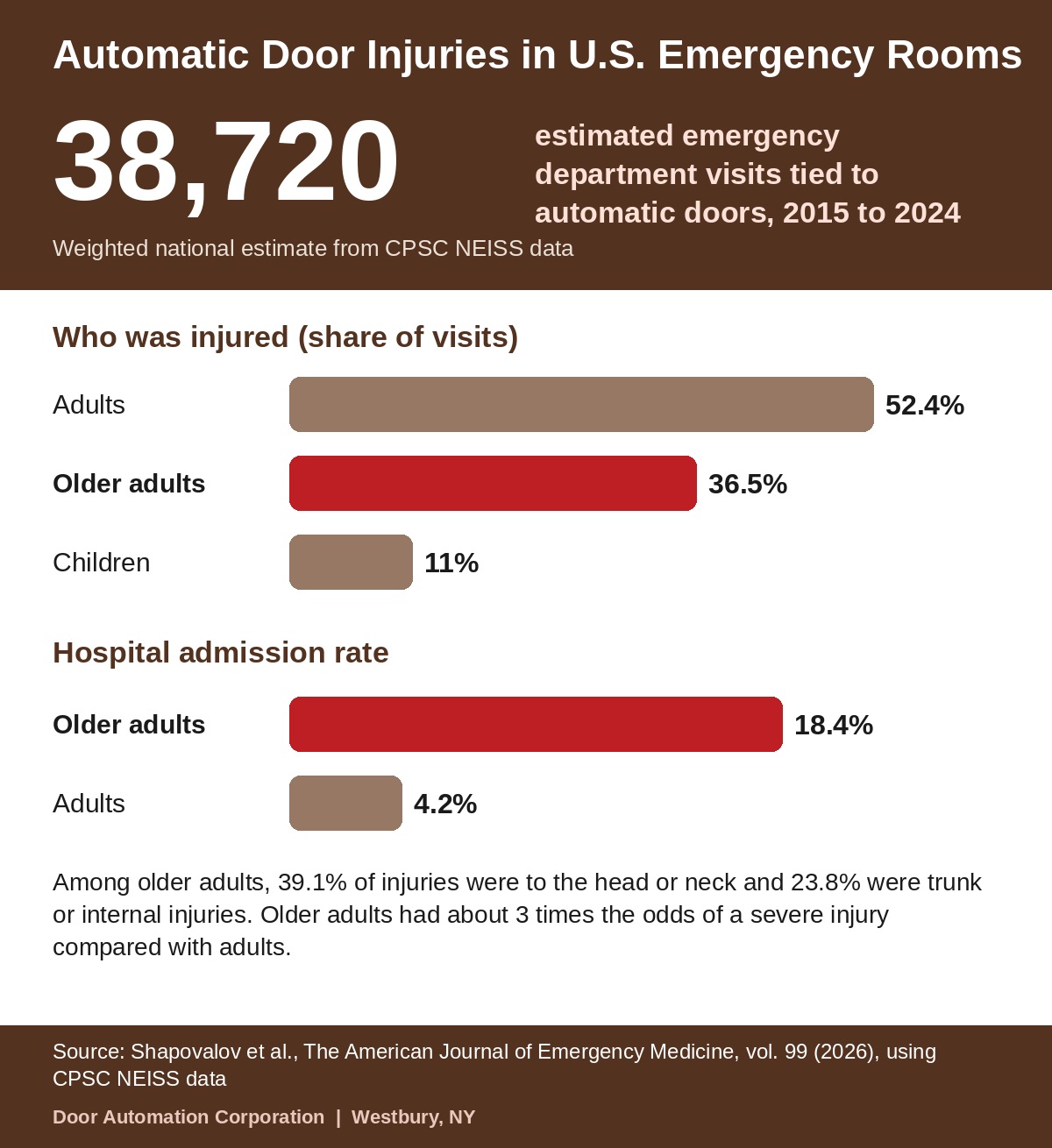
The injury data is a reminder of what is at stake. A 2026 study in The American Journal of Emergency Medicine analyzed U.S. Consumer Product Safety Commission injury data and estimated 38,720 emergency department visits tied to automatic doors from 2015 to 2024. Older adults were 36.5% of those visits and were admitted at 18.4%, compared with 4.2% for adults.
Doors that are inspected on schedule are also easier to keep running. Minor issues get caught before they damage the operator, rollers, or sensors, which lowers repair costs and limits downtime.
How to Schedule an AAADM Inspection in New York
To schedule an AAADM inspection in New York, contact a service company that employs AAADM-certified inspectors and can also repair what the inspection finds.
- Gather your details. Note the number of doors, the door types, your last inspection form, and any known problems.
- Book the visit in advance. Scheduling ahead keeps you from lapsing between annual inspections.
- Be on site or available. The inspector may need access to the header, controls, and breakout features.
- Review the results. Ask for the signed form, the completed label, and a written list of any repairs.
Door Automation provides annual inspections by certified technicians for New York properties, and there are several ways to keep them on a reliable schedule:
- Pair the inspection with scheduled preventive maintenance so one visit covers service and compliance.
- Lock in the calendar with a recurring service agreement for properties with several busy entrances.
- Standardize records across a portfolio with coordinated service across multiple locations.
- Keep settings, signage, and documents in order with entrance safety compliance support.
What to Do When a Door Fails an Inspection
When a door fails an inspection or a daily check, stop using it in automatic mode, secure it safely, and have a certified technician repair it before returning it to service.
AAADM’s guidance is to discontinue door operation immediately if you are unsure about safe performance. If the failed door blocks access or leaves the building unsecured, request 24/7 emergency service for unsafe doors instead of waiting for a routine visit.
Book Your AAADM Inspection with Door Automation in New York
Door Automation Corporation is a Westbury-based commercial entrance team with AAADM-certified technicians serving New York City, Long Island, Westchester, and Northern New Jersey. We inspect, maintain, and repair automatic and manual swing, sliding, and revolving doors, and we can fix what an inspection finds in the same relationship.
To get on the calendar, schedule your AAADM inspection and tell us how many doors you have and what types they are. Emergency service is available 24/7 at 516-678-4440, extension 2.
Property teams can also see the complete range of commercial door services that Door Automation handles.
AAADM Inspection Requirements FAQs
Are AAADM inspections required by law?
AAADM is a trade association and does not write or enforce law. It recommends an inspection after installation and annually thereafter, and the ANSI/BHMA standards expect doors to be maintained. Insurers, lease terms, safety auditors, or local authorities can still require inspection records, so confirm what applies to your building.
How often should automatic doors be inspected?
AAADM recommends that automatic doors be inspected immediately after installation and annually thereafter by an AAADM-certified inspector. Building owners or staff should also run a daily safety check. Busy entrances may need extra maintenance visits between annual inspections.
What does an AAADM inspector check?
An inspector tests sensors and detection zones, opening and closing speed and force, hold-open timing, breakout features, signs and labels, hardware condition, and the area around the door. The goal is to confirm the door meets the ANSI/BHMA standard that applies to it.
Who can perform an AAADM inspection?
Only an inspector certified through AAADM’s training and exam can complete an official AAADM inspection record. To earn certification, inspectors study the standards, attend a course with hands-on training, and pass an exam.
What is the AAADM annual compliance inspection label?
It is a section of the safety information label on the door that the certified inspector completes with the inspection date and inspector number after the door passes. Owners should also keep the signed inspection form or work order.
How much does an AAADM inspection cost?
Cost depends on how many doors you have, the door types, travel, and whether repairs are needed after the inspection. The most reliable way to price it is to describe your doors to a provider and ask for a quote.
Is an AAADM inspection the same as door maintenance?
No. Maintenance cleans, adjusts, and repairs the door to keep it running, while an inspection tests the door against the safety standard and documents the result. Many properties schedule both together so one visit covers service and compliance.
Does AAADM certification mean a technician can repair any door?
No. AAADM certification qualifies a person to inspect and test doors against the standards. It does not by itself mean the person is trained to install or repair every brand of operator, so look for a provider with certified inspectors and an experienced service team.
What should I do if my door fails the daily safety check?
Stop using the door in automatic mode, secure it safely, and do not try to repair or adjust it yourself. AAADM tells owners to call an AAADM-certified technician. If the door blocks access or leaves the building unsecured, call for emergency service.
How do I schedule an AAADM inspection in New York?
Contact a service company that employs AAADM-certified inspectors and can also make repairs. Door Automation serves New York City, Long Island, Westchester, and Northern New Jersey. Share the number of doors, door types, and any known problems when you request the visit.